

German Food: 30 Traditional Dishes and Drinks to Try
This article contains affiliate links. We may receive compensation if you make a purchase using one of these links at no additional cost to you. See our Disclaimers and Terms of Use for more information.


German food gets a bad rap.
Few people list food in Germany among their favorite global dishes and even fewer mention Germany when selecting their favorite food countries. That’s a shame.
Long a haven for beer drinkers and meat eaters, modern German food includes options for all kinds of diners and, contrary to popular belief, these options don’t all involve meat. Okay, many involve meat. But we’re okay with the extra protein since we’re carnivores. We’re okay with beer too!
Planning a Germany Trip?
Book these early. Germany is a popular destination.
- Food Tours: East Berlin food walking tour with Secret Food Tours or the Viktualienmarkt food tour in Munich with Lunch Like a Local
- Local Experiences: German food experiences with locals on Airbnb or a Munich beer and Bavarian bites tour
- Day Trip: Neuschwanstein Castle and Linderhof Palace tour from Munich
- Places to Stay: Hotels at all price points or an Airbnb apartment with a kitchen
- Rental Car: Rent a car to explore the Black Forest and the Romantic Road. Take trains between big cities.

Despite the country’s infatuation with pork and other meaty morsels, it would be naive to paint the entirety of German cuisine as one type of food. Not surprisingly, food in locations like the Black Forest and Bavaria is quite different from food in urban enclaves like Berlin, Hamburg and Düsseldorf. And then there are small towns and villages far from the tourist trails.
Further mixing the proverbial pot, Germany’s central European location places it in close proximity to countries like Austria, France and Poland, not to mention Italy, Slovenia and the Czech Republic. Those countries have all impacted German cuisine (and vice versa) as have relatively recent immigrants from India, Turkey and the Middle East.
🔑 Key Takeaways
- Currywurst is Germany’s signature street food. We ate our favorite at Curry 61 near Hackescher Markt in Berlin.
- German food changes by region. Hamburg means fischbrötchen and labskaus. Bavaria means brezeln, weißwurst and beer. Baden-Baden and the Black Forest mean spätzle and Black Forest cake.
- Not everything is old-school. Turkish immigrants turned döner kebab into one of the country’s most popular street foods.
- Timing matters. Go to Oktoberfest (late September to early October) for brezeln and weißwurst. Go to the Christmas markets (late November through December) for kartoffelpuffer.
- Service is included in the bill. Most Germans round up or add 5 to 10 percent for good service.
What to Eat in Germany

We’ve had plenty of occasions to dip our toes into German cuisine during quick trips as well as visits that spanned a week or longer. While we didn’t just eat in Germany, it was a primary goal as well as a pleasure to discover the country’s best food.
For ease of use, we’ve grouped our German food favorites into the following categories:
These are the German dishes that you’ll want to eat when you visit Germany or at your local German restaurant. If you’re industrious, you can even cook some of them in your home kitchen.
Iconic German Foods

Iconic German foods are both comforting and familiar.
Many of these foods made their way over the Atlantic thanks to German immigrants who earned the slightly misnamed moniker Pennsylvania Dutch. (Hey, it’s easy to confuse Dutch with Deutsch.)
Some globally famous German food doubles as bar food while other dishes are picnic and barbecue staples. And, it goes without saying, most taste best with mustard (or senf, as it’s called in German).
1. Pretzels (Brezeln)

Germans bake each brezel with five basic pantry ingredients: flour, malt, salt, yeast and water. But, once it’s knotted, boiled and baked, this simple treat ‘rises’ from raw dough to global icon status.
You’ve probably eaten brezeln if you live in the USA where they’re called pretzels. German immigrants introduced them to America centuries ago, and the knots kept spreading from there. We’ve eaten bready knots in countries as far away as South Africa just like we’ve done many a time in Philadelphia.

You won’t have to look hard to find a brezel in Germany since the carbalicious treat is sold at markets, train stations and bakeries throughout the country. Depending on your mood and hunger level, you can choose a traditional brezel, a sweet dessert version or a brezel sandwich.
So, you’re probably wondering how this famous twisted bread got its shape. There’s a legend involving a monk rewarding some kids with breads in the shape of praying arms. In our opinion, the legend is ridiculous. Solving the mystery would take a time machine.
Pro Tip
Ramp up your brezel experience by eating one topped with cheese unless you’d rather eat one topped with cinnamon sugar. As for us, we usually top our brezeln with spicy mustard.
2. Currywurst

If Germany were to have one signature snack food, that food would be currywurst.
In Berlin, kiosks, stands and stalls serve the iconic snack food from dawn until dawn. But currywurst isn’t just popular in Berlin. We’ve eaten the down-and-dirty dish in every single German city and town we’ve visited. It’s our version of a German guilty pleasure.
For the uninitiated, currywurst is a street food typically served on a paper plate. Cooks smother sliced wurst (sausage) with tangy curried tomato sauce and sprinkle a generous amount of spicy curry powder on top. Many vendors also serve a meat-free version for people who are vegetarian, kosher or halal.
Fun Fact
Herta Heuwer created currywurst in Berlin in 1949.
Expect to eat your currywurst with a pile of french fries, making this dish the perfect snack food or late-night treat. It’s the Berlin food that best exemplifies the city’s global approach to cuisine with elements from Germany (wurst), the USA (ketchup) and India (curry). But, most important, it pairs well with German beer.
3. Potato Pancakes (Kartoffelpuffer)

Kartoffelpuffer prove that not all potato products are created equal. Some, like this popular German market food, are better than others.
Typically served with applesauce, kartoffelpuffer are deep-fried in a vat of oil until they reach GBD (i.e., golden brown delicious) status. They also make a great side dish at German restaurants and with home-cooked meals.
We first encountered kartoffelpuffer at Christmas markets in Hamburg. Our first thought was “Hey, that looks just like a potato latke.” Seconds later, we knew that it tasted just like a potato latke too.
4. Berliner (Krapfen)

While JFK wasn’t claiming to be a donut when he famously stated “Ich bin ein Berliner,” we can understand any potential confusion on the matter. Most Germans call these jam-filled donuts Berliner. Berliners call them pfannkuchen and Bavarians call them krapfen.
Similar to other donuts eaten around the world, Berliner are yeasty pastries filled with jam, fried in oil and sprinkled with powdered sugar. You can eat one for breakfast with coffee or as an afternoon snack.
5. Sauerkraut

Sour fermented cabbage known as sauerkraut is so associated with Germany that it’s easy to forget that it’s eaten throughout Central and Eastern Europe. Then there are Alsatian French cities like Strasbourg where sauerkraut completes the meaty masterpiece called choucroute garnie.
Color us surprised when we learned that sauerkraut has roots more than 4,000 miles away in China. It’s not exactly a dish that we would think to eat with Yangzhou Fried Rice or Hunan Chicken. But, when we’re in Germany, sauerkraut pairs perfectly with pork, sausage and even schnitzel.
6. Spaetzle (Spätzle)
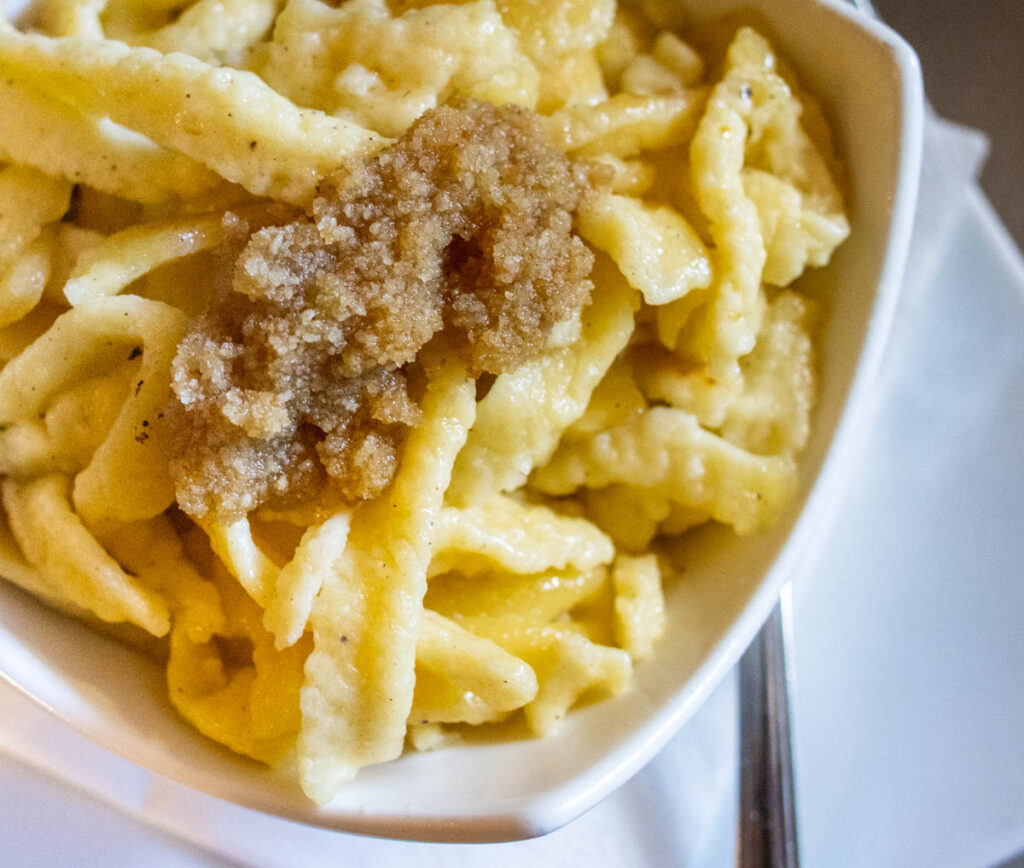
Spätzle, small noodles made with eggs, flour, salt and water, were originally made by hand three centuries ago in Southwest Germany. (The name itself comes from the word spatz, which is the southwest German word for sparrow.) Or were they? Similar noodles are also popular in nearby countries including Austria, France, Hungary and Slovenia.
No flash in the pasta pan, spätzle is easy to find on German menus. We like to pair the noodle dish with sauerbraten and schnitzel.
Discover more of the best noodle dishes in the world.
7. Potato Salad (Kartoffelsalat)

Germany isn’t the only country where people love potato salad, but Germans seem to love the chunky, starchy salad just a little bit more than their European peers in France, Italy, Scandinavia and Russia. While kartoffelsalat is particularly popular in Bavaria, warm potato salad without mayonnaise is served with dishes like schnitzel and currywurst throughout Germany.
Ironically, considering that potatoes are a new-world vegetable, German immigrants get credit for bringing potato salad to the USA. However, Americans modified the recipe by adding mayonnaise and chilling the dish except in Texas cities like Lockhart where locals eat warm potato salad with barbecued brisket. (This makes sense since many Germans immigrated to Texas.) It’s now an American food favorite at cookouts and picnics from sea to shining sea.
8. Dumplings (Knödel)

Like many dumplings around the world, Germany’s knödel are versatile. Some are sweet while others are savory. We like them all whether they’re served as a side dish with pork or filled with plums for dessert.
German cooks boil knödel after forming the dumplings with bread crumbs, stale bread or potatoes. Knödel made with matzoh meal are called matzoh balls, a knödel variety that’s particularly near and dear to our hearts.
Starters

Sometimes we wonder why Germans eat starters since many of their main dishes are so hearty. But then we remember why as soon as we slurp a savory soup or chomp on a tasty salad.
9. Goulash Soup (Gulaschsuppe)

Germany didn’t invent goulash. That honor goes to Hungary, the country where goulash’s popularity reigns supreme. However, don’t rule out eating gulaschsuppe in Germany, which is exactly what we did on a chilly day in Baden-Baden.
The German version of goulash is heartier and thicker than the Hungarian version. Typical proteins include beef and pork though more adventurous cooks add venison and wild boar to their stews. When done right, gulaschsuppe is German comfort food in a bowl.
Discover more of the best soups in the world.
10. Meat Salad (Wurstsalat)

Germans take their love for meat to the next level when they add strips of sausage to salad and create meat salads called wurstsalat. Literally translating to sausage salad, these meaty salads provide a protein punch before diners eat the main course featuring (you guessed it) more meat.
Typical wurstsalats include pickles and cheese. Others, like the one we ate in Baden-Baden, add veggies for good measure. Either way, as indicated by the dish’s name, meat plays a starring role in any proper wurstsalat.
Discover more of the best salads in the world.
11. Liver Dumpling Soup (Leberknödelsuppe)

Not everybody loves liver. But those who do (like Daryl) will want to try leberknödelsuppe at least once in their lives. The name of this German soup literally translates to liver dumpling soup and that’s exactly what it is: soup with liver dumplings. Beyond Germany, the soup is also a popular meal starter in Austria and the Czech Republic.
Although leberknödelsuppe has origins in Bavaria, we have yet to eat this soup in Germany. Instead, Daryl practically inhaled a bowl at a German-American restaurant in Buffalo. As for Mindi, she saved her appetite for beef on weck since she’s not a liver fan.
12. Tartare (Tartar)

We typically think of France when we think of tartare, especially steak tartare made with raw beef and egg yolks. Mindi adores the dish and often orders it in French cities like Paris, Lyon and Dijon.
Germany has its own version of tartare called tartar. Although many German tartar recipes feature meat, we ordered a version made with smoked trout, horseradish, cucumber and wild herbs in Baden-Baden. Ideal for pescatarians, the fish-forward tartar works for us too.
Sausages

The country has no shame in cooking and eating wurst, i.e., sausage, at markets and restaurants as well as in homes. The varieties number in the dozens and come in various shapes, sizes and flavors.
13. Bratwurst

Crafted with beef, pork and veal, bratwurst is Germany’s most popular sausage at home and around the world. Germans typically grill bratwurst links, put them in a bun and add plenty of mustard. Americans eat them the same way at baseball games and summertime cookouts.
Eating a bratwurst on its own is only half of the story. The best way to eat bratwurst is with sides of sauerkraut and kartoffelsalat. These two sides complete the bratwurst experience and turn the sausage sandwich into a meal.
Like French cheeses, bratwurst varieties take the name of their town or region. Different varieties include finger-sized Nürnberger rostbratwurst from Nuremberg (see below), wine-flavored Würzburger bratwurst from Würzburg and large, flavorful Thüringer rostbratwurst from the state of Thuringia.
Pro Tip
You can find bratwurst sandwiches at many of the same kiosks that serve currywurst, making it easy to check these two foods off your German food bucket list at the same time. Be sure to add a healthy amount of yellow senf (mustard) for the full bratwurst experience.
14. Nuremberg Bratwurst

Small in size but big in flavor, Nuremberg bratwurst prove that not all bratwurst links are the same. Locals have been eating them for centuries but not one at a time. Instead, they eat three on a bun or six on a plate. They often invite sauerkraut and kartoffelsalat to the meat fest. Mustard adds the finishing touch.
Not wanting to break with tradition, we ate Nuremberg bratwurst like locals when we visited Nuremberg. We’re all about following local protocols, especially when they involve eating grilled sausage and other tasty bits.
15. Liverwurst (Leberwurst)

Liverwurst stands out from other wursts for two main reasons. First, it’s made with pork liver. And, second, it’s a spreadable meat product.
Not surprisingly, Germans often eat liverwurst with sauerkraut and kartoffelsalat. They also spread it on bread and make sandwiches with added ingredients like mustard and pickles. Sometimes they add cheese to ramp up both the protein quotient and flavor. We approve of the addition.
16. White Sausage (Weißwurst)

Living up to a name that translates to white sausage, pale white weißwurst links made with veal and pork fat are indeed white. They stay pale because cooks skip the curing salt (i.e., sodium nitrite) that turns most German sausage pink. Bavarians traditionally peel off the skin and eat weißwurst before noon.
We must admit that we’ve bucked tradition numerous times when it comes to eating weißwurst in Germany. We prefer to eat the meaty morsels later in the day along with a beer or two. Sue us.
Main Dishes

There’s only so much sausage that anybody can eat. Luckily, Germany’s main dishes include a range of proteins including beef, chicken, pork, seafood and venison. Some are even meat-free.
17. Schnitzel

Although its origin can be traced to Austria, schnitzel is a classic German food enjoyed throughout Deutschland.
German schnitzel is similar to Austrian schnitzel. Cooks traditionally prepare both versions by coating pounded veal or pork steak with a mixture of breadcrumbs, eggs and flour before frying the coated meat until it achieves a crunchy, crispy exterior.
Pro Tip
Plan to eat schnitzel along with kartoffelsalat and pickled cucumbers when you order it as a main dish. Be sure to pair it with a glass of German white wine to achieve maximum schnitzel satisfaction.
18. Sour Roast (Sauerbraten)

Sauerbraten is an iconic German main dish that’s typically served at family dinners with sides like spätzle and boiled potatoes. However, food travelers can easily find sauerbraten on restaurant menus throughout the country.
Although sauerbraten literally translates to sour roast, the finished meat dish isn’t really sour. Rather, the dish gets its name from the sweet and sour sauce that cooks use as marinade before they roast the meat low and slow. Savory gravy completes the dish while sides turn it into a meal.
19. Pork Knuckles (Schweinshaxe)

Schweinshaxe isn’t the type of main dish that you’d want to eat every day. The dish is basically a pork knuckle that’s been cooked low and slow. When prepared well, the dish’s meat remains juicy while the skin develops a crispy crunchiness.
If you’re lucky, you can sample schweinshaxe at a family dinner unless the family is serving sauerbraten instead. However, if you’re like us, you can eat a schweinshaxe as big as your head at a German restaurant.
20. Hamburg Meat Mash (Labskaus)

Historically eaten by hungry sailors, labskaus is a reddish North German mash of corned beef, beets, potato and onions that tastes like a fluffier corned beef hash. Modern Germans eat the dish at restaurants when they’re looking for a tasty hangover cure.
We couldn’t resist ordering labskaus at a Hamburg tavern even though we didn’t have hangovers. Keeping to tradition, the dish came topped with fried eggs and rollmops (pickled herring rolled around pickles) on the side. Our verdict? It looked kind of weird but tasted kind of great.
Sandwiches and Snacks

Like many countries around the world, Germany has a thriving street food culture. While some stands sell currywurst and sausage sandwiches, others offer choices more appropriate for people who follow halal and vegetarian diets.
21. Döner Kebabs

Germany’s Turkish community, which grew out of the 1960s guest worker program, gave the country one of its most popular foods: the döner kebab.
Introduced by Turkish immigrants in the 1970s, the döner kebab has attained cult status throughout Germany in cities big and small over the decades. And why not? The Turkish-inspired sandwich is as filling as it is tasty.
Germany’s döner kebab is the food we crave after a late-night drinking session in Berlin where the sandwich originated. When it comes to curing a hangover before it develops, there’s little better than scarfing down a pita roll filled with thinly sliced meat carved from a rotating spit.
Pro Tip
After you top your döner kebab with ingredients like cabbage, cucumbers, onion and tomatoes, don’t forget to add spicy sauce for an extra burst of flavor.
22. Fish Sandwiches (Fischbrötchen)

Most cities have a signature sandwich and Hamburg is no exception.
Fischbrötchen, served at stands all along the Elbe, is as simple as fish on a bun. However, since the sandwich’s flavors can be complex with a variety of fresh fish and tasty toppings, we consider the fischbrötchen to be one of the best sandwiches in the world.
Typical fischbrötchen fish options include herring and salmon while popular toppings include horseradish, pickles and onions. We opted for salmon when we ate our first fischbrötchen in Hamburg. It was a good decision.
23. Hamburgers

Some historians trace the history of cooked ground beef back to Hamburg, so it’s only fitting that Hamburgers, i.e., the people of Hamburg, have embraced what many see as an American sandwich as their own. This history goes back to the 19th century when Hamburgers ate ground beef patties called frikadellen after a long day working at the docks.
But the ground beef patty, originally referred to as a Hamburg steak, evolved into today’s world favorite by way of the United States. Where the modern version of the hamburger truly originated is debatable with no definitive history.
Still, it’s fun to eat hamburgers in their namesake city.
Discover the world’s best burgers.
24. Iskender Kebap

The iskender kebap takes the döner kebab to the next level by topping thinly shaved lamb meat with tomato sauce, sheep’s milk butter and yogurt. Although it uses the same meat used to create döner kebabs, the extra ingredients give this German fast food favorite an extra zing.
Unlike the döner kebab, the iskender kebap wasn’t invented in Germany. Its origin lies in Turkey where it was invented during the 19th century. Regardless of its heritage, we associate the tasty dish with Germany and order it whenever we see it on a menu.
25. Meatballs (Königsberger Klopse)

Similar to iskender kebap, the meatball dish called königsberger klopse is a German comfort food staple with roots in another country. In this case, those roots are in Königsberg, the Prussian city that’s now Kaliningrad, Russia, where cooks first covered meatballs with capers and white sauce.
You won’t have any trouble finding königsberger klopse on menus at traditional German restaurants. Alternatively, you can eat naked meatballs at urban food halls if you’re not in the mood for the traditional version’s rich white sauce.
26. Pickles (Gurken)

Produced in Brandenburg using a traditional recipe and local ingredients, Spreewälder gurken became Germany’s most famous pickles after earning protected status. But Brandenburg’s pickles aren’t the only pickles produced and eaten in Germany.
It’s fair to say that Germans have mastered the art of pickling over the years. Some German pickle brines are sweet while others are sour. Ingredients like dill and mustard seeds provide extra flavor whether the cucumbers are big or small.
Since we grew up eating kosher pickles, we rarely say “no” to gurken, i.e., German pickles, whenever we see them at a breakfast buffet or on a meat plate. We’ve also been known to munch on a gurke or two while wandering around German markets.
27. Rollmops (Rollmöpse)

Unlike kosher pickles, we didn’t grow up eating rollmops or any related food product. Let’s face it, while they’ve been part of German cuisine for centuries, rollmops aren’t exactly common in America. In fact, we never encountered rollmops until we saw and ate the fishy food at a Hamburg food market.
As we learned during that first encounter, Germany’s rollmops are pickled herring fillets wrapped around savory items like pickles, olives and onions. While we didn’t dislike those rollmöpse filled with pickle chunks, we consider this particular German snack food to be an acquired taste that we have yet to acquire.
Desserts

Don’t let German austerity make you think that German people don’t like dessert. Scratch that. They don’t like dessert. They love it!
While the list of German desserts is extensive, the following two sweet treats are the ones not to miss:
28. Black Forest Cake (Schwarzwälder Kirschtorte)

While some people venture to Germany’s Black Forest to live out a Grimm fairy tale fantasy or buy a cuckoo clock, dessert lovers hike into the hills for cake. And not just any cake. This forest inspired the creation of schwarzwälder kirschtorte, more commonly known as Black Forest cake and Black Forest gâteau.
No fairy tale villain, this cake channels good over evil with its intensely chocolate cake, fresh cherries, whipped cream and chocolate shavings. The addition of kirsch (cherry brandy) is the literal cherry on top of this iconic German dessert.
Discover more great German desserts as well as desserts around the world.
29. Apple Strudel (Apfelstrudel)

Apfelstrudel is an Austrian dessert that feels like it should be a German dessert. We’re apparently not alone with this feeling since apfelstrudel is popular all over Germany but especially in Bavaria.
To make apfelstrudel, bakers fill layers of unleavened dough with sweet apple filling. With hints of cinnamon, apfelstrudel is a good dessert to eat after dishes like schnitzel and sauerbraten. Toppings like vanilla sauce and whipped cream elevate apfelstrudel to great status.
Discover great German candy.
30. Beer (Bier)

Germans rank among Europe’s biggest beer drinkers, trailing only a few countries like Czechia and Austria. The country has been brewing and drinking beer for a millennium. And not just one type of beer.
German beers run the gamut from light lagers to dark dunkels to even darker schwarzbier. Then there are beers brewed specially for Oktoberfest and Christmas, niche beers like smoky Rauchbier and regional beers specific to cities like Cologne (Kölsch) and Düsseldorf (Altbier).
If you’re wondering which German beer is best, there’s only one way to find out. We say drink them all to find the answer. Pace yourself though. German beer steins are big and the selection of German beer is even bigger. We have our personal favorites and you will too.
Discover more great German drinks beyond beer.

🌐 Useful Germany Food Travel Info

💡 Frequently Asked Questions
Pretzels (brezeln), bratwurst, currywurst, sauerkraut and schnitzel are the German foods most people know. Black Forest cake and beer round out the list.
Germany doesn’t have an official national dish. Sauerbraten (i.e., marinated pot roast) gets cited most often. Currywurst and döner kebab are the most popular.
Brötchen (i.e., crusty rolls) with butter, cold cuts, cheese and jam. In Bavaria, a weekend breakfast might be weißwurst with a brezel, sweet mustard and a wheat beer.
More than its reputation suggests. Look for käsespätzle (i.e., cheese spätzle), kartoffelpuffer, brezeln and knödel. Many currywurst stands, including Curry 61, also serve a meat-free version.
Beer is the obvious answer, and styles change by region (Kölsch in Cologne, Altbier in Düsseldorf, Rauchbier in Bamberg). Germans also drink a lot of Riesling, sparkling water and apfelschorle (i.e., apple juice with sparkling water). See our German drinks guide for more.
Service is included, so tipping isn’t required. Most diners round up or leave 5 to 10 percent. When you pay, tell the server the total including tip instead of leaving cash on the table.
We vote for Berlin and Hamburg for their variety, including international options. Baden-Baden is our pick for Black Forest classics. Check out our Berlin food guide, Hamburg restaurant guide and Baden-Baden restaurant guide.
🇩🇪 Germany Travel Checklist
🎥 Video Recap
🍴More European Food


📍 Pin This Article


⚙️ Disclosures
Article Updates
We update our articles regularly. Some updates are major, while others are minor link changes and spelling corrections. Let us know if you see anything that needs to be updated in this article.
Funding
We purchased and ate the food featured in this article.
