

21 Traditional Christmas Desserts Around the World
This article contains affiliate links. We may receive compensation if you make a purchase using one of these links at no additional cost to you. See our Disclaimers and Terms of Use for more information.


Traveling in December has distinct benefits…
Most countries celebrate with sparkly lights, elaborate decorations and festive music. European Christmas markets add extra zing with vendors selling local food, artisan crafts and hot wine.
🔑 Key Takeaways
- Most traditional Christmas desserts are seasonal. Look for them from late November until Dia de Reis on January 6, when Portugal’s bolo rei finally leaves bakery shelves.
- Christmas breads rule in Europe. Italy’s panettone, Germany’s stollen and Portugal’s bolo rei are rich, fruit-studded breads that double as dessert.
- Christmas markets are great places to sample several treats at once, from heart-shaped lebkuchen to chimney cakes and têtes chocos.
- Not every Christmas dessert is designed for cold weather. In New Zealand, pavlova topped with fresh berries is a summer Christmas staple.
- You don’t need a plane ticket. Christmas cookies, eggnog and struffoli are all easy to make at home.

Who are we kidding?!!
Traveling in December lets us sample traditional Christmas desserts around the world. We’re happy to eat Christmas goodies with our hands, a spoon or a fork. On cold days, we pair them with seasonal sippers that warm us up from the inside out.
Fun Fact
We also enjoy eating Sufganiyot when we celebrate Hanukkah. The seasonal jelly donuts pair perfectly with savory Potato Latkes.

Unlike most global desserts, Christmas desserts are usually only available in December and early January. That short window gives us extra motivation to plan winter trips to countries like France, Germany and Italy that have awesome Christmas markets and equally awesome Christmas desserts.
Many seasonal sweets have centuries of tradition behind them. In France, families once saved the bûche de Noël for after midnight mass, while German monks baked lebkuchen as far back as the 13th century. Here in Portugal, bolo rei stays on the table until Dia de Reis on January 6, which gives us a few extra weeks to eat it.
Our Favorite Christmas Desserts

Some Christmas cakes and pastries evoke warm memories of past holidays spent with friends and family. Then there are holiday desserts that create fresh memories when we taste them for the first time.
Don’t ask us to pick one favorite holiday confection. That would be both wrong and impossible. We can’t even narrow them down to a dozen.
Read on to discover our picks for 21 of the best Christmas desserts in the world.
1. Bûche de Noël (France)

For the French, one bûche de Noël on Christmas Eve is never enough.
French families often have two bûches de Noël during the holidays: a decorated wooden yule log that burns in the fireplace and a cake that’s now eaten all season long.
More than just a doppelganger, the bûche de Noël cake is an impressive culinary creation that involves rolling iced sponge cake into a cylinder and decorating it with chocolate buttercream, ganache, twigs and berries.
However, in recent years, swanky Paris pâtisseries have gone beyond simple iced jelly rolls, creating colorful entremets in flavors like white chocolate, hazelnut and even yuzu. Since this unique French dessert is seasonal, we say go for it if you travel to France in December. Just be careful not to eat an actual wood log unless that’s your thing.
Discover more classic French desserts.
2. Panettone (Italy)

Originally baked in Milan centuries ago, panettone’s popularity has spread throughout Italy and around the world thanks to Italian immigrants and savvy marketing executives. Today, it’s one of the world’s most iconic Christmas breads.
Less sweet than most Italian desserts, panettone is Italy’s puffy round version of brioche baked sky high and cooled upside down to retain its height. Beyond its eggy, buttery bread base, panettone gets its flavor from ingredients like candied fruit, chocolate chips and raisins.
Discover more traditional Italian desserts.
3. Bolo Rei (Portugal)

Bolo rei is the king of holiday desserts in Portugal.
Topped with colorful candied fruit, the circular brioche-like cake (think of a ring-like version of Italy’s panettone) lines the shelves at pastry shops and markets throughout the country during a holiday season that runs until January 6, when Dia de Reis (Epiphany) is celebrated. If you visit Portugal during Natal, these jeweled rings are almost impossible to avoid.
We ate our first bolo rei in Porto in November 2020 and bought a big ring when we got back to Lisbon. However, we later found our favorite bolo rei at Confeitaria Nacional, the historic Baixa pastelaria (i.e., bakery) that introduced Portugal’s most popular Christmas confection back in the 19th century.
Discover more Portuguese desserts and pastries.
4. Christmas Cookies (Everywhere)

Christmas cookies are popular around the world and for good reason. They’re fun to bake at home and swap with friends. They also make excellent hostess gifts and look festive when displayed at holiday parties and dinners.
Beloved American Christmas cookies include iced sugar cookies, decorated gingerbread men and chocolate-topped thumbprints. Other countries have their favorites too.

Part of the fun of traveling in December is nibbling on waffle-like pizzelles in Italy, shortbread bredeles in France and spiral spritzgebäck in Germany. However, motivated munchers can find these classic Christmas cookies at specialty bakeries around the world.
Discover more cookies to eat throughout the year.
5. Stollen (Germany)

Germany’s stollen has stolen our hearts.
It’s not that the simple Christmas bread studded with candied fruits and nuts is particularly unique. But, as we discovered in Baden-Baden, versions baked with mandel (i.e., almonds) and marzipan hit our breakfast sweet spot. Plus, its top layer of powdered sugar doesn’t hurt stollen’s cause.
We weren’t the first to discover stollen’s charms. Its history dates back to the 16th century when stollen was more of a savory bread than a dessert. It quickly became popular in German cities like Dresden, a town famous for hosting one of Germany’s oldest Christmas markets as well as an annual stollen festival in December.
Discover more German desserts and pastries.
6. Eggnog (England)

Eggnog tastes good all year but especially during the holidays, when revelers spike the milky, spicy beverage and top it with grated nutmeg. It’s also the season when calories don’t matter so much.
While eggnog’s history traces back to 15th-century England and later involved George Washington, our personal eggnog history involves ladling the festive drink out of large punch bowls at holiday parties. After we moved to Lisbon, we developed an easy recipe so that we could whip up a batch for a party of two.
Follow our Bourbon Eggnog recipe and whip up a batch for yourself and a special friend.
7. Joulutorttu (Finland)

While the French go to the woods for bûche de Noël inspiration, Finns go galactic by baking star-shaped joulutorttu. Pardon our cliché in advance… but these pastries are out of this world!
We bought ours at a Helsinki market in December. After all, it’s much easier to buy the seasonal sweet than it is to mold buttery dough into stars and top each pastry with homemade prune jam.
Discover more treats to enjoy when you celebrate Christmas in Helsinki.
8. Struffoli (Italy)

Finding sweet treats in Naples is the opposite of a challenge. They’re everywhere. And, while most Neapolitan pastries are available all year long, some are linked to specific celebrations. There’s the graffa (Carnival), pastiera (Easter) and zeppole di San Giuseppe (Feast of St. Joseph) just to name a few. Struffoli is the city’s Christmas treat.
Struffoli’s roots may derive from Greece’s loukoumades, but the Neapolitans have made it their own. It’s a fun treat that screams Naples with its deep-fried crunchy dough balls, multi-colored sprinkles and sticky-sweet honey coating.
Discover more Neapolitan pastries.
9. Lebkuchen (Germany)

Despite its kitschy appearance and similarity to gingerbread, Germany’s lebkuchen is a traditional Christmas treat that dates back to the 13th century when monks first baked the seasonal sweet. Unlike those crafty clergy, modern Germans like to buy heart-shaped lebkuchen at Christmas markets.
Not only are decorated lebkuchen hearts festive, but buying them also saves time. The recipe calls for a long list of ingredients including eggs, flour, honey, sugar, nuts, candied orange and lemon peel as well as exotic spices like anise, cardamom, cinnamon, cloves, ginger and mace.
There is one tradeoff for this shortcut. While homemade lebkuchen is soft-textured, the version sold at markets is harder and crunchier.
Check out the best Hamburg Christmas markets.
10. Pavlova (New Zealand)

Although it sounds like a Russian delicacy, the pavlova was created to honor visiting Russian ballet dancer Anna Pavlova. New Zealand and Australia both claim it as their own.
The base of a pavlova is meringue prepared with cornflour. However, the addition of fruits like kiwis and passionfruit makes the pavlova a true New Zealand dessert. Adding red berries to the mix transforms the pavlova into a Christmas confection. Since Christmas occurs during the summer down under, finding fresh berries in December is easy for Kiwis.
Discover more great New Zealand foods.
11. Pain d’Épices (France)

Pain d’epices (i.e., gingerbread) is an Alsatian quick bread usually baked with a variety of spices including cinnamon, nutmeg, cloves and, of course, ginger. Beyond Alsace, it’s also a local specialty in Burgundy where it’s sold in various shapes and sizes.
It only seems right to eat pain d’epices in Strasbourg since the French city is filled with houses straight out of the Hansel and Gretel fairytale. Meanwhile, pain d’epices is so popular in Dijon that it’s even used to flavor mustard.
12. Chocolate-Covered Marshmallows (Various)

We didn’t realize that chocolate-covered marshmallows were a Christmas treat until we saw têtes chocos prominently displayed at Christmas markets in Dijon, Lyon and Strasbourg. Clearly, we had been missing out.
Like other chocolate-covered marshmallows we’ve eaten in Canada, Scotland and the USA, têtes chocos have a cookie base, marshmallow center and chocolate coating. However, France’s version offers fillings like framboise, cappuccino and honey.
13. Nevaditos (Spain)

It rarely snows in Spain, but nevaditos get a fresh dusting every Christmas. The dense cookies take their name from nieve (i.e., snow), and the snow is powdered sugar.
14. Risalamande (Denmark)

Rice pudding is popular all year in Denmark, but Christmas is when Danes eat risalamande, made with almonds, sugar, vanilla and whipped cream. Red berries and cherry sauce complete the festive Danish dish.
Danes have been eating risalamande since the 19th century after adapting it from a French recipe. Traditions related to this Danish dish include eating it with malt beer and awarding a prize to the diner who finds a whole almond in the dessert.
Discover more Danish food favorites.
15. Nougat (Various)

Chewy nougat candy, made with egg whites, honey and nuts, is especially popular throughout southern Europe and South America during the Christmas season. Spain calls this candy turrón while Italy calls it torrone; however, neither of these countries gets credit for inventing nougat.
As it turns out, nougat’s roots trace back more than a millennium to the Middle East. But Europe gets credit for elevating nougat to Christmas treat status. Round or square, soft or crunchy, nougat almost always tastes great.
16. Christmas Pudding (England)

Christmas pudding is proof that all good things, like Christmas, are worth the wait. Made with brandy and a variety of fruit, both dried and candied, this holiday dessert takes time to achieve its unique texture.
Brits have been eating the dark, sticky pudding for centuries and they’re not alone. The dense dessert is also popular in former colonies like Australia, Canada and South Africa. Although it had its moment in America, Christmas pudding’s popularity in that former colony was as fleeting as the flame that often lights the dessert on fire.
17. Chimney Cake (Various)
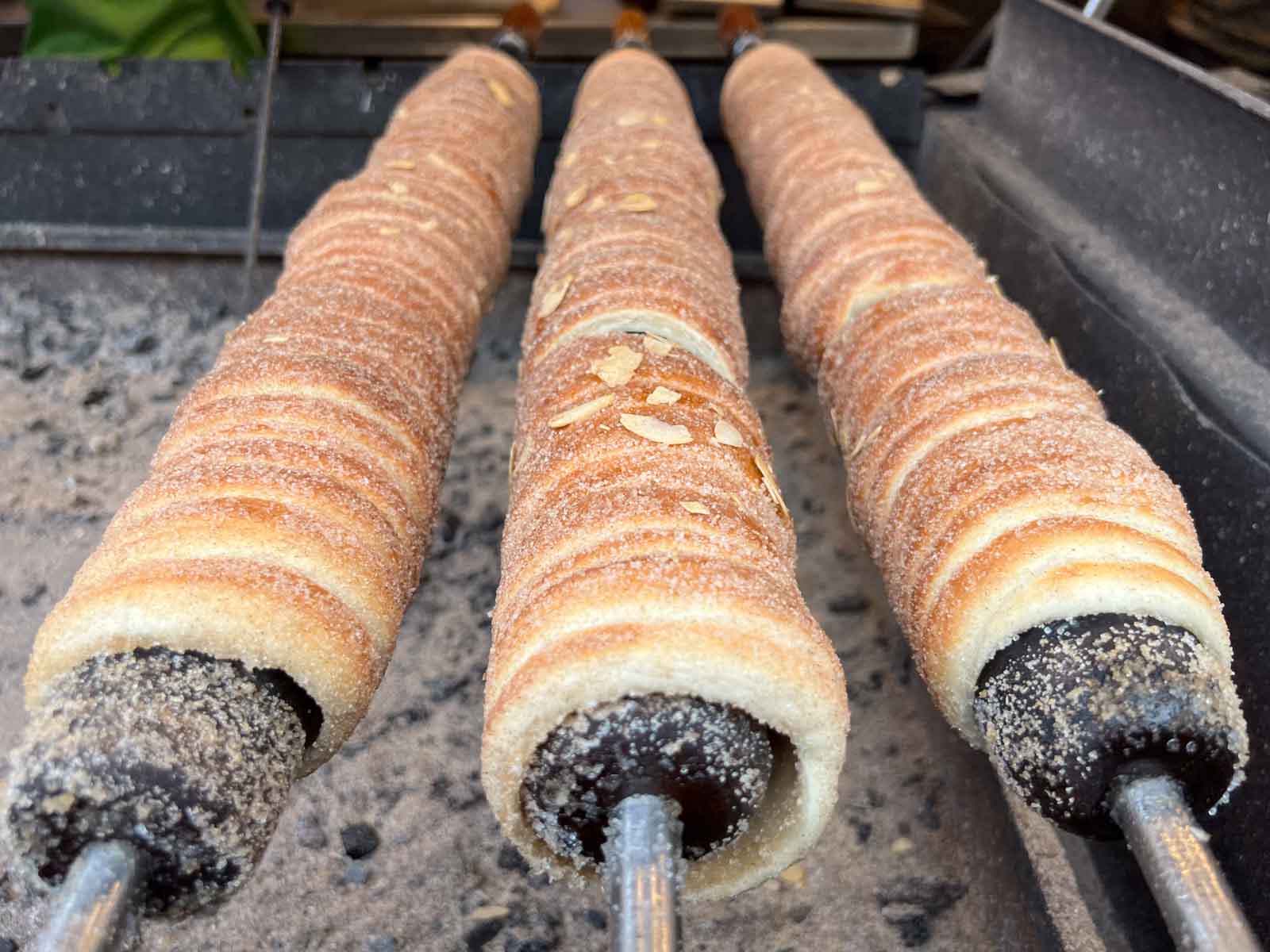
Chimneys are important in December.
Not only do families hang Christmas stockings by the chimney with care, but chimneys are also Santa’s entry point for delivering gifts. And then there are chimney cakes sold at Christmas markets in countries like Germany, Hungary, Lithuania and Poland.
A staple at Eastern European markets, chimney cakes have simple ingredients like butter, eggs and flour. Market vendors wrap dough around a wooden spool which they rotate over a fire until the chimney cake achieves a crunchy exterior. It’s fun to watch the process and even more fun to take that first bite.
18. Fruit Cake (USA)

American fruit cake gets a bad rap.
Despite being the butt of many a joke, the dense cake made with fruits, nuts, spices and liquor has kept its spot at the Christmas table for more than a century. It’s also wiggled its way into a Jimmy Buffett song aptly called Fruitcakes and Truman Capote’s autobiographical A Christmas Memory.
Much of its dubious reputation comes from mass-produced alcohol-free fruit cakes given as corporate Christmas gifts and to random relatives. However, homemade versions baked with brandy ensure that fruit cake is here to stay.
19. Christmas Candy (Everywhere)

Christmas candy makes the holiday season sweeter for kids of all ages. Candy canes and chocolate Santas are probably the most popular, but peanut brittle, peppermint bark and seasonal M&M’s also make the list.
Discover the world’s best candy.
20. Bolo de Mel (Portugal)

If you only have time to eat one dessert when you visit the Portuguese island of Madeira, that dessert should be a bolo de mel. A sweet cake made with molasses as well as spices like cinnamon and clove, it dates back to the 15th century when Portugal was a major player in the spice trade. The traditional Christmas dessert is available year-round on the island at local bakeries, markets and tourist shops.
21. Buccellato (Italy)

Sicilians bake a roster of delicious pastries (hello cannoli!) year-round. In December, they add buccellato to their baking repertoire. The classic Christmas dessert is essentially a Sicilian fruitcake made with almonds, hazelnuts, figs, orange, raisins and other local ingredients. Extra bits like candied fruit and chocolate add both color and flavor to each slice.
While home cooks have been baking large ring-shaped buccellato cakes for centuries, some modern pastry shops prepare individual portions that are great to eat on the go. Regardless of the size, buccellato is a Christmas dessert that pairs well with coffee in the morning and adult beverages in the evening.
💡 Frequently Asked Questions
Bûche de Noël in France, panettone in Italy, stollen in Germany, Christmas pudding in England and bolo rei in Portugal are among the most traditional. Each Christmas dessert has been part of its country’s holiday table for generations.
It depends on where you celebrate. Panettone probably travels the farthest: Italian immigrants carried the sweet around the world, and supermarkets stack it high every December. Christmas cookies are the clear favorite in the US.
Panettone is a tall, airy Italian bread made with eggs and butter and studded with candied fruit, raisins or chocolate. Stollen is a dense German loaf filled with dried fruit and nuts, often with a marzipan center and a thick coat of powdered sugar.
Christmas pudding, fruit cake and stollen all improve with time, so you can bake them weeks ahead. Lebkuchen and most Christmas cookies also keep well if you store them in an airtight tin.
Christmas markets in Germany and Alsace are hard to beat for lebkuchen, pain d’épices and chimney cakes. We also love eating struffoli in Naples and bolo rei here in Lisbon.
Iced sugar cookies, gingerbread men, peppermint bark and candy canes top the list. Fruit cake shows up too, though its reputation is mixed.
🎥 Video Recap
🥮 More Sweet Treats


📍 Pin This Article


⚙️ Disclosures
Article Updates
We update our articles regularly. Some updates are major, while others are minor link changes and spelling corrections. Let us know if you see anything that needs to be updated in this article.
Funding
Unless otherwise noted, we purchased and ate the desserts featured in this article.
