

Banh Mi Sandwich: A Fusion of Tasty Flavors
This article contains affiliate links. We may receive compensation if you make a purchase using one of these links at no additional cost to you. See our Disclaimers and Terms of Use for more information.


With roots in Vietnam, the banh mi sandwich is one of the most popular sandwiches in the world. Learn how to make a tasty version at home regardless of where you happen to be located.

Ranking up there with Philadelphia’s cheesesteak, Vietnam’s banh mi is arguably one of the greatest sandwiches in the world. But the popular Vietnam street food isn’t just a tasty bite – its mere existence is a case study on how multiculturalism has influenced Vietnamese cuisine.
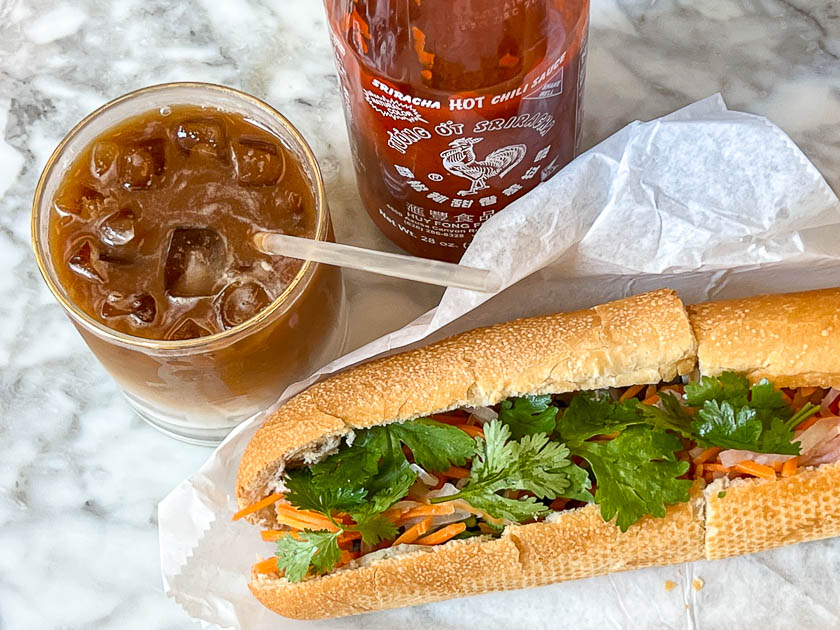
It’s easy to point to the French and their baguette baking traditions as a primary influence on the banh mi’s origin. However, it’s also plausible that the banh mi was also influenced by years of American occupation. It only makes sense that homesick Americans may be responsible for the sandwich’s hoagie-like heft and appearance. The American connection only grew stronger once the sandwich traveled to the US.
Thanks to Vietnamese diaspora, the banh mi has become a favorite in American cities with large Vietnamese populations like Houston, New Orleans and our home city of Philadelphia. But, despite its French roots and American influences, the banh mi is pure Vietnam with grilled protein at its nucleus, funky fish sauce, verdant lemongrass, vinegary pickled vegetables and a garden full of herbs.
Discover more Vietnamese Food Favorites.
Banh Mi Essentials

Over years of travel, with the exception of Portugal and maybe France and Italy, we’ve spent more time in Vietnam than any other country. During multiple trips, we’ve eaten banh mi sandwiches in Hanoi in the north, Da Nang and Hoi An in the center of the country and Ho Chi Minh City (Saigon) in the south. Outside of the banh mi’s specific native ingredients and flavors, the sandwiches were distinctly different based on their location.

Hanoi vendors placed pâte in the center of our banh mi sandwiches. In Hoi An, Banh Mi Queen’s Madam Khanh slathered our sandwiches with delicious locally-made chili jam. Also in Hoi An, clerks at uber-popular Banh Mi Phuong added a variety of pickled vegetables and standard accoutrements like lettuce and tomato to our sandwiches.
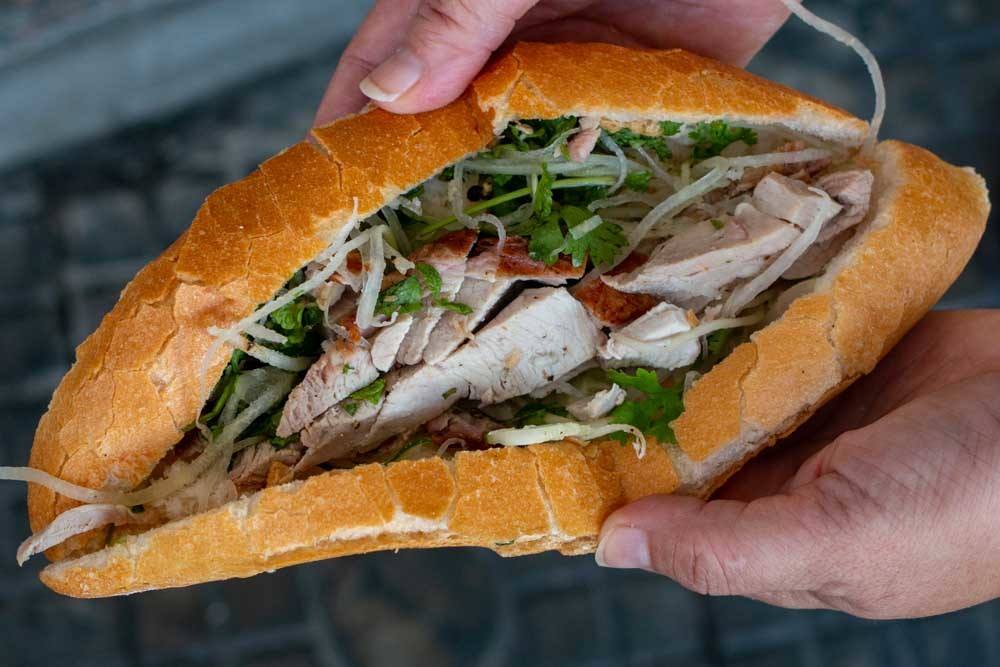
We probably ate the most banh mi sandwiches in Da Nang since we lived there for five months. In that central Vietnamese city, generic vendors sell cheap yet tasty sandwiches on nearly every street corner. Additionally, established shops like Tiem Banh Mi Heo Quay Chi Lanh construct outstanding banh mi sandwiches with large hunks of meat cleavered off homemade roasts of pork. Meanwhile, the ones we ate in Saigon, including a breakfast version called Banh Mi Op La, were served with a plethora of sauces.
Beyond the fillings, there’s something special about banh mi bread. In both Vietnam and America, savvy bakers create cracklingly crisp banh mi rolls. If you can get those rolls in your hometown, more power to you. Living in Portugal, we have to ‘settle’ for French-style baguettes baked at artisan bakeries. It’s no sacrifice. The essence and flavors of a truly great banh mi can be achieved with this bread too.
Ingredients and Prep Work

Since we love the banh mi, we wondered how to make the sandwich at home. What rules would we need to follow, if any even exist? And could we even recreate the flavors outside of Asia? Spoiler Alert: We can and we did.
As we learned, when it comes to making banh mi at home, there are certain elements that define the sandwich. Those elements start with a crunchy roll, followed by pickled slaw, a marinated protein perfumed in Vietnamese spices and flavors and, finally, lots of fragrant green leafy herbs. If you ever go to Vietnam, you’ll find that fresh herbs are the signature ingredient of Vietnamese dishes like in pho and rice and, in this case, sandwiches.
In this banh mi recipe, with those essentials in mind, we started building our sandwich with an earthy pâté base and, after adding pickled slaw (daikon and carrot) and grilled chicken, we artfully topped it with cucumbers and green chili peppers (both optional) as well as plenty of fresh cilantro and mint. But, first, we marinated the chicken with traditional Vietnamese ingredients like lemongrass, cilantro, garlic and fish sauce. We finished the chicken with a hoisin sauce glaze for sweetness in the last minute it was grilling in the pan.
Read on to discover the required ingredients and prep work in each stage of the banh mi build out.
1. Vietnamese Pickle (Đồ Chua)

This pickle is inspired by Kenji Lopez-Alt at Serious Eats and requires the following ingredients:
Ingredient quantities are detailed in the printable recipe card below.

Cut the carrots and daikon into long julienned matchsticks. Use a long sharp knife if your knife skills are good or a mandoline if you’re feeling brave. (Mandolines can be dangerous. We encourage you to use a safety glove if you choose to use that tool.) We used a multipurpose Y peeler with a special attachment to slice the daikon and we julienned the carrot by hand.
Once you slice the vegetables, mix them thoroughly with salt and sugar. Pour the marinade over the vegetables and place the entire mixture, including the liquid, into a well-sealed Mason jar. The mixture should optimally sit in the refrigerator for about two days. You can use any leftover slaw in a variety of applications including as a side for rice or in salad.
2. Vietnamese Chicken Marinade

Here are the marinade ingredients:
Ingredient quantities are detailed in the printable recipe card below.
We used a large mortar and pestle to create our Vietnamese marinade and you may want to do the same. Another option is to use a food processor. For sweetness, we glazed the grilled chicken with hoisin sauce after we grilled it. We initially added the hoisin to the marinade but found that the sugary sauce burned when we heated it. Once again, we solved that problem by glazing the hoisin on the chicken before removing it from the pan.
In this recipe, you’ll marinate the chicken before it’s cooked. While banh mi vendors typically use a charcoal grill to cook the chicken, we used a cast iron pan to cook the chicken. If you don’t have a cast iron pan, you can alternatively use a standard stainless steel pan or even a teflon pan.
Prior to cooking the chicken, mix the marinade ingredients together, pounding or processing them to form a paste. Marinate the chicken for at least an hour or for as long as a full day.


Once you’re ready to cook the chicken, put the chicken breast, along with the marinade, into the pan and cook at medium until both sides are dark brown, not burned. Use a thermometer to ensure that the temperature reaches at least 150°F / 60°C. (While it’s recommended to cook chicken breast to 160°F / 71°C to avoide foodborne illnesses, pathogens typically die at 140°F.) If the ingredients begin to scorch, add a little water to deglaze the pan.
Brush hoisin sauce onto the browned chicken and continue to cook for two to three minutes. Remove the cooked chicken from the pan and add about a quarter cup of water to deglaze the pan. Once the remaining hoisin sauce gets thick, move it to a small bowl – you’ll later pour that sauce over the chicken when you build the sandwich.


Place the marinated and glazed cooked chicken breast on a plate and let it rest for about five minutes before slicing it. Finally, assemble all the ingredients – it’s now time to build the sandwich.
3. Building the Banh Mi Sandwich

It’s easy and fun to build a banh mi sandwich based on personal taste and preferences. Accordingly, consider the following ingredients as a guideline and certainly not mandatory:
Ingredient quantities are detailed in the printable recipe card below.
You’ll want to generously top your banh mi in true Viet style with fresh herbs. While cilantro is the most common choice, you can also add fresh mint.
Pro Tip
Sub the pâté with a creamy mild cheese like Laughing Cow if you’re not a fan of pâté. The spreadable American cheese is a typical banh mi ingredient in Vietnam.
How To Make a Banh Mi Sandwich

Although assembling a Banh Mi is relatively simple, we’ve found that it’s important to follow a certain order with the construction. You’ll want a base of pâté, a layer of vegetable pickle, a layer of the protein and then a green herbaceous finish.
Start by cutting open the baguette by unhinging it. Do NOT slice the roll all the way through.


Once cut, open the baguette and spread an even layer of the pâté. Layer in the daikon/carrot slaw.


Next, layer on the protein, which is grilled chicken breast in this recipe. Spoon on the pan sauce.


Finally, artfully layer on the herbs as well as sliced cucumber and/or sliced green chili peppers (both optional).

Warning – Once you eat the banh mi sandwich, it won’t be long until you start dreaming about making it again.


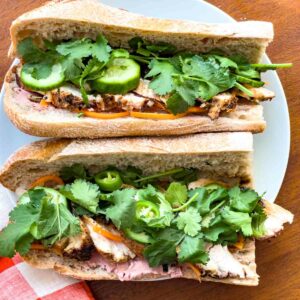
Banh Mi Recipe
Ingredients
Carrot and Daikon Pickle
- 1 daikon (medium to large, julienned into long strips using a sharp knife or mandoline)
- 2 carrots (large, julienned into long strips using a sharp knife or mandoline)
- 1/4 cup sugar
- 10 grams table salt
- 1 cup water
- 1/2 cup rice vinegar (white rice wine vinegar)
Marinated Pan Grilled Chicken
- 1 chicken breast (medium to large, boneless and skinless)
- 1 stalk lemongrass (Lightly pounded and thinly sliced)
- 1 teaspoon light soy sauce
- 1/2 teaspoon dark soy sauce
- 1 shallot (large, sliced widthwise into medium slices)
- 2 lime zest (coin sized pieces, finely julienned)
- 2 tablespoons lime juice (freshly squeezed)
- 4 sprigs cilantro (including stems)
- 6 white peppercorns (whole)
- 1/4 teaspoon coarse salt
- 2 cloves garlic (medium, cut into small pieces)
- 2 tablespoons vegetable oil (plus an additional tablespoon of oil for cooking)
- 2 tablespoons hoisin sauce
Final Sandwich Assembly
- 1 baguette (16" baguette or two small baguettes)
- 50 grams pâté (chicken or any other type of liver based)
- 2 cups daikon and carrot slaw
- 1 chicken breast (pan grilled and marinated, sliced in 1/2" slices)
- 1 cup fresh herbs (cilantro and mint recommended)
- 1 cucumber (thinly sliced, optional)
- 1 green chili pepper (thinly sliced, optional)
Equipment
- Food Processor (optional)
- Mandoline (optional)
- Y-Peeler (optional)
Instructions
Carrot and Daikon Pickle
- Mix the julienned carrot and daikon in a bowl with sugar and salt until well combined.
- Pour and mix the vinegar and water into the bowl and mix well.
- Pour the mixed ingredients into a 1 quart (1,000 ml) maison jar, cover tightly and place in the refrigerator for at least one day and as long as one month. Twist off the top of the jar every four days to release any air.
Marinated Pan Grilled Chicken
- Pound and mix the lemongrass, soy sauces, garlic, shallot, white peppercorns, cilantro, salt and vegetable oil using a mortar and pestle until mixed and well incorporated. You can also use a food processor for this step.
- Pour the marinade and the raw chicken breast into an airtight bag and refrigerate for at least one hour and up to a day.
- When you're ready to cook the chicken, heat a cast iron pan over medium heat. Pour a tablespoon of oil into the heated pan. Once the oil is heated and shimmering, pour in the entire chicken breast with the marinade and cook for about 6 to 8 minutes on each side until the chicken is firm and cooked – about 150°f / 66°c. After the chicken is cooked, brush it with hoisin sauce and cook it for one more minute. Deglaze the pan with a 1/4 cup of water if the bottom of the pan starts getting too brown. (Don't let the marinade burn and scorch.) Rest the cooked chicken on a cutting board.
- After the chicken is cooked, deglaze the pan with another quarter cup of water and scrape any brown bits off the bottom of the pan. Cook the marinade until it gets slightly thick and forms a dark yet flavorful sauce. Pour that sauce into a small bowl
- Slice the chicken on a bias into 1/2 inch (1.25 cm) slices. Set the chicken and sauce aside for final sandwich assembly.
Building the Banh Mi Sandwich
- Slice and unhinge the baguette. Do NOT slice it all the way through.
- Build the sandwich by adding the pâté as the base sandwich layer followed by the daikon/carrot slaw.
- Add the sliced chicken and pour the sauce over the chicken. Optionally add sliced cucumber and a few green chili slices. Complete the sandwich by garnishing it with fresh herbs.
Notes
- You can substitute the chicken with cooked proteins like roast pork or even steak. If you replace the chicken with shrimp or tofu, consider replacing the pâté with spreadable cheese..
- While the finished sandwich will easily feed four for lunch, it can also be served in generous dinner portions for two.
Nutrition
💡 Frequently Asked Questions
A banh mi is a Vietnamese sandwich. It’s essentially a crunchy baguette that’s filled with a protein, pickled vegetables, a base of creamy pate or cheese and lots of fresh herbs.
The banh mi was invented in Vietnam.
Specially made Vietnamese bread is best if you can find it or make it. If not, a crunchy, French style baguette is the next best option.
While this banh mi recipe includes marinated grilled chicken breast, the sandwich’s protein variations are limitless. We’ve eaten banh mi with pork belly, pulled pork shoulder, tofu, ham and even shrimp.


📍 Pin This Recipe


