

Polvo à Lagareiro: Portuguese Octopus
This article contains affiliate links. We may receive compensation if you make a purchase using one of these links at no additional cost to you. See our Disclaimers and Terms of Use for more information.


Join us in our quest to cook a delicious dinner using an intimidating ingredient. Our cornclusion? Cooking tasty, tender octopus is way easier than we expected. We suspect you’ll feel the same when you cook the popular Portuguese octopus dish, Polvo à Lagareiro, at home.

What’s the best way to cook octopus? Some people boil it with corks. Others hang the cephalopod on ropes by the seaside before beating it with a stick. We’ve even heard about a special machine that tenderizes the ‘pus’ with rocks.
We found these techniques while researching how to cook octopus since, as Americans, it’s not something we grew up eating at home. After talking with chefs, watching videos and reading a number of recipes, we also found that cooking octopus isn’t rocket science (or, as Mindi says, rocket surgery).
As we learned, the key to cooking octopus is all about the cooking time. Slow cooking is the best way to go. We also learned that all we needed were a few simple tools like baking dishes, aluminum foil and an oven to cook octopus that’s super tender. (In fact, our first try was almost too tender, if there’s such a thing. We’ll get to that later.)
Our Cooking Approach

For our first foray into cooking the eight-tentacled sea creature, we chose to cook our octopus lagareiro style. Polvo à Lagareiro, which apparently has roots in the northern province of Trás-os-Montes, is a Portuguese food favorite that’s become a holiday staple in its home country. If you celebrate Christmas, and even if you don’t, we recommend the dish for your next Feast of the Seven Fishes.
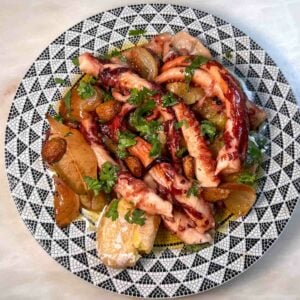
The dish, which is popular at Lisbon restaurants, features octopus that’s cooked until tender and finished at high heat so that its outside is brown and crisp. Cooks typically plate the octopus over small roasted smashed potatoes and then douse it with oil.


Some restaurants in Lisbon, like O Velho Eurico, literally brown the cooked octopus on a flat-top grill to crisp it up. Since this technique sounds logical, we thought we would follow this method. But, upon doing further research, we discovered an even better method while watching a show featuring one of Portugal’s most famous TV chefs.
Filipa Gomes, who could be described as the Rachael Ray of Portugal, appears on the Portuguese channel 24Kitchen just about every time we turn it on. In her signature 1940s-esque attire, Gomes demonstrates a wonderfully different home-kitchen-friendly way of approaching the dish. She roasts the octopus over a base of oil with aromatics, slow cooking the octopus until it’s tender. While the octopus is cooking, she roasts and subsequently smashes the potatoes. She then serves the octopus over the potatoes and douses the dish with hot garlic-infused oil.

In this ‘homestyle’ dish, the octopus is not browned in the same manner as in most restaurants and yet the resulting dish is wonderfully comforting. The octopus liquid and olive oil combine to create a deep sauce that tastes like it came directly from the Atlantic Ocean. The sweet onions melt and disintegrate while bay leaves perfume the dish. The combination of allium and bay leaves is pure Portugal. And, since octopus is surprisingly rich in collagen, the briny sauce coats the tongue.
Discovering Gomes’ recipe was the impetus for us to conquer our trepidation. Was our first try perfect? No. We probably needed a bigger octopus since the smaller octo we cooked ended up a bit too tender. Many Portuguese would say that the meat should have more resistance when poked with a fork. However, we still loved the homestyle nature of the dish and have already cooked it again. Cooking octopus gives us as much of a thrill as Portuguese explorers da Gama, Magellan and Balboa got with their discoveries. We can’t wait to make it yet again once the dank winter weather is in full force.
Ingredients

In this recipe, the two most important ingredients are octopus and fingerling potatoes. The potatoes should be simple to find and the octopus, since it’s frozen, can be specially ordered if you can’t buy octopus at your local seafood market.
Ingredient quantities are detailed in the printable recipe card below.
How To Make Octopus à Lagareiro

Making this dish is simple and can be done in less than two hours. The hardest work is in the prep and handling of the octopus. After that comes the timing of when to place the potatoes in the oven. Our two and a half pound octopus cooked quickly. Some might say that our octopus was TOO tender, but that’s debatable based on personal preference. (You could always shorten the cooking time by 10 to 15 minutes if you’re not on team tender.)
We recommend using a four-to-five pound octopus which feeds four people. You can use a smaller or larger octopus but, if you like a firmer texture, make sure you check the octopus for doneness after about an hour of cooking. This is especially the case if you opt for a smaller octopus as we did.
After preheating an oven to 400°F/ 200°c, start by unwrapping the octopus. Be not afraid!

Grab it by the body and reach under the base of the head. You’ll see the beak/eye. Reach behind the beak and squeeze. The beak will then pop out. Once it’s popped, use a knife to slice the beak off. It’s official. Your octopus is now clean and ready for cooking.


Drizzle olive oil generously over the bottom of a glass baking dish and place the octopus on top of the oil.
Evenly spread peppercorns over the octopus and then place the onion quarters evenly around the octopus in the pan.
Douse the top of the raw octopus with more olive oil.


Cover the octopus pan tightly with aluminum foil and place it in the oven. Set the timer for 90 minutes.


In the meantime, place the potatoes in a bowl of cold water. About 35 minutes before the octopus is done cooking, remove the potatoes from the water and place them a baking pan and sprinkle salt evenly over the potatoes.
Mix the potatoes until they’re covered with a thin but generous layer of salt.


With 30 minutes left on the timer, place the baking dish with the potatoes on a separate rack in the oven.

About 5 minutes before the octopus is cooked, heat the olive oil in a small saucepan. Add garlic cloves and fry for a couple of minutes until they’re brown on the edges. Remove the pan from the heat.
Remove the octopus and potatoes from the oven. Remove the foil from the octopus and check for doneness by sticking a knife into the octopus. The knife should remove easily. Do the same with the potatoes.


Gently brush the salt off the potatoes and smash them with your hand (palm or fist) or gently with a spatula.

It’s now time to plate the dish.
Start by laying down the potatoes. Cover the potatoes neatly with the octopus slices. Pour on the hot garlic oil (including the cloves) and garnish with chopped cilantro or parsley.

The finished dish is ideal for a holiday meal. However, it tastes great any time of the year.


Polvo à Lagareiro Recipe
Ingredients
- 1 whole octopus (4 to 5 pounds, frozen and cleaned)
- 12 fingerling potatoes (skin on)
- 1 large onion (peeled and quartered)
- 1 teaspoon black peppercorns (whole)
- 1.5 cups olive oil (extra virgin)
- 2 tablespoons salt (fine grain)
- 2 bay leaves
- 1/2 cup cilantro leaves (coarsely chopped for garnish)
Equipment
Instructions
- Preheat an oven to 400°F/ 200°C.
- Clean the octopus by cutting off the small beak.
- Generously drizzle the bottom of a rectangular baking dish with olive oil. Lay the octopus on top of the oil. Sprinkle the peppercorns and lay the bay leaves on top of the octopus. Place the quartered onion around the octopus and drizzle the top of the onions in olive oil.
- Cover the baking dish tightly with aluminum foil and place in the oven for 90 minutes or until tender. You'll know that the octopus is done by inserting a knife into the tentacles. There should be little or no resistance from the octopus.
- About 50 minutes after the octopus has started cooking, soak the potatoes in a bowl of cold water. Remove the potatoes from the water and into a separate baking dish. Sprinkle the potatoes with salt until they're liberally covered.
- 30 minutes before the octopus finishes cooking, place the baking dish with the potatoes on a separate rack in the oven.
- Five minutes before the octopus has finished cooking, pour 3/4 of a cup of the olive oil into a small saucepan and heat on medium. Once the oil is heated, add the garlic cloves. Cook the garlic until brown. Remove the pan from the heat so that the garlic doesn't burn.
- Smash the potatoes with either your hand or with the wide side of a knife. Place the smashed potatoes on a serving plate. Cut the tentacles off the octopus and lay the tentacles over the potatoes. Pour the hot garlic oil, including the garlic cloves, over the octopus. Garnish with chopped cilantro and serve.
💡 Frequently Asked Questions
Polvo à Lagareiro is a Portuguese dish that pairs cooked octopus with smashed roasted potatoes and a generous amount of olive oil.
Legend has it that Polvo à Lagareiro has roots in Trás-os-Montes in Northern Portugal.
Octopus, Smashed Roasted Potatoes, Bay Leaf, Olive Oil, Garlic, Onion, Salt, Pepper and Cilantro (garnish)
It takes about two hours to cook Polvo à Lagareiro from start to finish.


📍 Pin This Recipe


