

Fresh Tomato Sauce: Pasta’s Perfect Partner
This article contains affiliate links. We may receive compensation if you make a purchase using one of these links at no additional cost to you. See our Disclaimers and Terms of Use for more information.


There’s no debate that summer is the best time to make fresh tomato sauce. However, if you have a good can of tomatoes or a bottle of passata, it’s a good time to make tomato sauce regardless of the season.

Until you’ve made it at home, tomato sauce has an almost mystical quality. It’s time to bust that myth.
As Americans, we grew up commending local Italian restaurants for the quality of their sauces as if the recipes were written by Massimo Bottura. However, making a basic tomato sauce is actually super simple for home chefs like us. In fact, tomato sauce is the first dish that many people truly cook at home from scratch.
This is especially true each summer. For two to four months from June to September, depending on where you live, good ripe tomatoes are relatively easy to find at local farmers markets and supermarkets. There’s a certain vegetal nature to fresh red tomatoes that simply can’t be replicated. The sauce you make from them is a rare treat that no other sauce, not even sauce made with high-quality canned tomatoes imported from Italy, can match.
That being said, you can also make a great sauce at home with both fresh and canned whole tomatoes or passata (a special blanched, unseasoned tomato puree generally made in Italy.) In fact, some people prefer using canned tomatoes. This preference may be due to the quality of the source of the tomatoes, especially if the canned tomatoes were grown on an Italian volcano like Mount Vesuvius. But to us, there’s still something exhilarating about making and eating the fresh stuff.
Whichever tomatoes you use, if you do all the basics, you can create a magnificent sauce that will shine on its own but especially on top of quality pasta.
Ingredients

This is essentially a four-ingredient recipe if you subtract the staples (i.e., olive oil, salt and pepper). And, if you use canned tomatoes during the off-season, you may have everything you need to make tomato sauce in your pantry.
Ingredient quantities are detailed in the printable recipe card below.
How To Make Fresh Tomato Sauce

Making fresh tomato sauce incorporates all of the great elements of cooking in the kitchen.
When you make tomato sauce from scratch, you see how heat and liquid break down the walls of the tomato, softening it into a pasty liquid. You also witness evaporation when the water dissipates from the mixture as it thickens from a soup to a sauce. These are keys to understanding the basics of flavor – how the almost electric charge of salt brings the sweet, acidic and umami flavors of the tomato to life and how ingredients like onion and garlic provide flavor structure against the sweetness of the fruity tomatoes.
So let’s go!
The first step in this recipe is to bring a large pot of water to a boil. While the water in the pot is heating, cut crosses into the non-stem end of each tomato with a paring knife. Then, once the water comes to a boil, drop all of the tomatoes into the pot and blanch them for one to two minutes. Remove the tomatoes and place them in an ice bath or a bowl filled with cool water.


Once cool, peel the tomatoes. The skin should practically slide right off.

Once the tomatoes are peeled, cut them into quarters so that they break down neatly once they’re in the pot. With this approach, you won’t make a mess when you press and stir the tomatoes because the tomatoes won’t burst. You can always scrape the extra liquid off the cutting board and into the pot when you add the tomatoes.
Pro Tip
You can use a food mill to puree the tomatoes if you want your sauce to be smooth. We prefer our tomato sauce to have a chunkier, more rustic consistency.
Heat the pan for a few minutes on medium heat and then pour in the olive oil. Once the olive oil is heated, sauté the chopped onions until they’re just softened and slightly translucent. Once they’re soft, add the garlic and stir for about a minute until the garlic is just fragrant.
Note
You can add canned tomatoes or tomato passata directly to the sauté if you’re using one or both of those products. With respect to passata, just about 10 minutes of cooking is necessary.


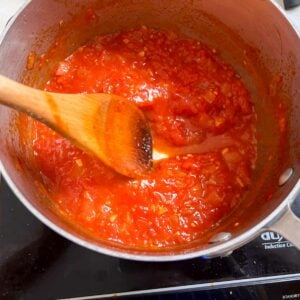
Pour in the tomatoes and any accumulated juice on the cutting board. Stir, pressing the red tomato flesh against the side of the pot while stirring.
The tomatoes will begin to break down after about 10 minutes. Turn the heat down to simmer and cook the tomatoes, stirring in the same manner until the tomatoes have totally broken down and the mixture becomes saucy.
Pro Tip
Add water any time that the mixture gets too thick to prevent the sauce from burning.


Once the tomatoes have broken down and the sauce is thick, add salt and pepper to your taste.


This is the point in the recipe when it’s best to add fresh herbs. We simply tear our basil but you can chop it if that’s your preference.
Put your sauce aside and cover it to keep warm while you boil the pasta.
Partnering the Sauce with Pasta

For this recipe, we paired our fresh tomato sauce with hearty rigatoni noodles produced by The Pasta Lab in Philadelphia. Their dense, earthy pasta gets its flavor and heft from organic stone-ground spelt flour and other ingredients from the mid-Atlantic region.
Making this kind of pasta is an expensive process that can only be achieved using a pasta extruder with special brass dies. The result is hearty, toothsome and wonderful. Plus, the pasta’s rough outer surface allows the sauce to cling to the noodles, which is ideal.

Once you choose your pasta for this recipe, prepare it according to the box or bag’s instructions. (Our pasta’s instructions specified an eight-minute boil.) Be sure to set aside a half cup of the pasta water before straining the pasta.
Fish out the pasta directly from the boiling water using tongs or a large slotted spoon. After straining it, add the pasta to a large sauté pan.
Add three to four ladlefuls of sauce to the pan if you’re making a small amount of pasta for just a couple of people. Contrarily, if you’re making an entire box of pasta for a family, add all of the sauce.

Mix the pasta and sauce over medium heat until they’re incorporated. If you choose to finish the sauce with a cheese like Pecorino or Parmigiano-Reggiano, turn off the heat and let the pan stay on the hot burner. After three minutes, add the grated cheese and stir until everything is cohesive.
Plate in small, flat bowls. Garnish with torn fresh basil unless you opt to use a different herb.

Fresh Tomato Sauce Recipe
Ingredients
- 2 pounds plum tomatoes
- 1/2 medium onion (finely chopped)
- 3 cloves garlic (minced)
- 3 tablespoons olive oil (extra virgin)
- basil (to taste)
- 1/4 teaspoon chili flakes (optional)
- salt (to taste)
- black pepper (to taste)
Equipment
Instructions
- Cut an x on the non-stem end of each tomato with a paring knife.
- Bring water to a boil. Blanch the tomatoes for one minute and then move them to an ice bath.
- Peel the tomato skins after the tomatoes are cooled. (They should peel off easily.) Once peeled, cut the tomatoes into quarters.
- Heat a saucepan over medium heat. Add the olive oil. Once the oil is shimmering, add the chopped onion and sauté until soft and translucent. Add the garlic and cook until fragrant, about one minute. If you choose to add chili flake, stir it in now.
- Add the tomatoes to the pan, making sure to scrape everything from the cutting board including the liquid. Turn the heat on low.
- Simmer the tomatoes for one hour, stirring about every 10 minutes with a wooden spoon. As you stir, press the tomatoes against the side of the saucepan to help break down the tomatoes. Add a little bit of water to the mixture if it becomes too thick or sticks to the bottom of the pan.
- After an hour, the tomatoes should have a pasty, saucy consistency. After adding salt and pepper to taste, tear and mix in the fresh basil. Place a lid over the sauce to keep it warm.
- Serve by mixing it with your favorite pasta.
Notes
- You can substitute the fresh tomatoes with a 28 oz. can of canned tomatoes or 500 milliliters (approximately one pint) of passata.
- You can freeze the sauce in a plastic container for up to six months
- You should have enough sauce for one pound of pasta.
- You can add herbs like tarragon, parsley or mint instead of basil to create new flavor combinations.
Nutrition
💡 Frequently Asked Questions
Making fresh tomato sauce should take about 90 minutes from start to finish.
Plum or roma tomatoes work well due to their minimal amount of seeds. However, you can use any kind of tomato you wish when you make fresh tomato sauce at home.
Yes, especially if tomatoes are out of season. We recommend using a 28-ounce can of tomatoes or about 500 milliliters of passata for this recipe in lieu of fresh tomatoes.
Once your sauce is finished, taste it and correct for salt. Our best advice is to add a little bit of salt at a time until the sauce has the flavor you prefer.
You can use whatever herb you wish outside of cilantro. (You can even use cilantro if that’s the way you wish to go.) And, while you could use a dry herb like oregano, we recommend using fresh herbs to honor the spirit of the recipe.


📍 Pin This Recipe


