

Andalusia Food Guide: 30 Must-Try Dishes and Drinks
This article contains affiliate links. We may receive compensation if you make a purchase using one of these links at no additional cost to you. See our Disclaimers and Terms of Use for more information.


Discover the best things to eat and drink when you travel to Córdoba, Granada, Málaga and Seville. Must-eat Andalusian foods include local dishes, Spanish classics and irresistible desserts. The drinks are great too!

Most people think of Barcelona and Madrid when they think of Spain. However, flamenco, tapas and much of the legendary hodgepodge of Spanish culture originated in Andalusia. It’s where guitars rapidly strum and olive trees stretch as far as the eye can see. It’s also where mosques have become churches and where walled cities harbor the traces of long ago cultures.
Located in the south of Spain, Andalusia’s rich history spans centuries. Roman conquerors lived here as did the Moors. And, prior to their expulsion in 1492, more than 100,000 Sephardic Jews called Andalusian cities like Córdoba and Granada home. The presence of those former residents is easy to see in Andalusia’s striking architecture and its poetic literature. It’s also easy to taste in the region’s cultural mosaic of dishes.
Andalusia’s geography is equally vast and varied. Not only does it kiss the Mediterranean Ocean, but it also has multiple mountain ranges and countless fields overflowing with grape vines and olive groves. The resulting bounty is enough to keep carnivores, pescatarians and vegetarians equally well-fed and happy.
🇪🇸 Andalusia To Do’s
Andalusia is a popular destination, so you should book your tours, hotel and rental car ASAP. These are our top picks:
📸 Tours and Activities
1. Andalusia Food Experiences with Locals (a great way to taste the region)
2. Cordoba Food Tour (tapas and wine)
3. Granada Food Tour (tapas and wine)
4. Malaga Food Tour (tapas and wine)
5. Seville Food Tour (tapas and wine)
🏨 Accommodations
1. Hotel (rooms at all price points)
2. Airbnb (Rome apartments with kitchens)
🚗 Rent a car to explore the region. Do NOT drive in the city.
Must-Eat Andalusia Food

As we’ve experienced during multiple trips, the food in Andalusia is special. Not only does the region’s cuisine reflect its history and geography, but it also reflects modern day influences and eating habits. Most important, it’s some of the tastiest food in all of Spain.
Read on to discover our favoritie Andalusia dishes and drinks. Plan to try as many as possilbe starting with tapas.
1. Tapas

The best Andalusia tapas bars serve small plates topped with pescaito frito (fried seafood), jamón Iberico (Iberian ham) and albonidags (meatballs) as well as glasses filled with cerveza (beer), vino (wine) and vermut (vermouth). And, while small plates have, over recent decades, become trendy at bars and restaurants around the world, tapas has been part of Andalusian life for centuries.
Eating tapas is a great way to sample a variety of Andalusian dishes without breaking the bank. It’s also a fun way to connect with locals who fill tapas bars every day of the week.
Pro Tip
Some Andalusian tapas bars serve a complimentary tapa with each purchased drink. This practice is especially common in Granada.
2. Rabo de Toro

Rabo de toro, a tasty dish in which oxtail is braised in red wine for hours, is one of many iconic Spanish dishes with roots in Andalusia. It’s also a dish with a fun origin story that involves Córdoba bull fighters and clever cooks. Eating this slow-cooked dish is a must for anybody who appreciates juicy meat that literally falls off the bone.
Pro Tip
Pair rabo de toro with a big red wine from La Rioja or Ribera del Duero. The combination is a match made in Spanish food heaven.
3. Salmorejo

It would be easy to confuse salmorejo with gazpacho. The two chilled tomato soups look similar and both have roots in Andalusia. However, while both soups are refreshing to eat during the hot summer months, they’re not exactly the same. While gazpacho is typically sipped from a glass, Andalusians serve salmorejo in a bowl. Often, they top those bowls with diced jamón and hard-boiled eggs.
Typical salmorejo ingredients include tomatoes, day-old bread, garlic, olive oil, salt and sherry vinegar. It’s easy to find the creamy, cold mixture at tapas bars and restaurants throughout Andalusia. And, if you fall in love with salmorejo, you can easily blend up a batch once you’re home.
Pro Tip
Eat like a local and pair your bowl of salmorejo with tortilla de patatas. It’s not uncommon to see both on the same plate with the salmorejo acting as a sauce for the tortilla.
4. Flamenquín

Despite its name which literally translates to little Flemish, flamenquín is a 20th-century dish with roots in Andalusia. It’s also one of the strangest dishes we’ve eaten in the food-focused region.
Cooks prepare each flamenquín by rolling jamón (ham) with pork loin cutlets into a tubular shape or roulade. They then coat the rolled meat in bread crumbs and deep fry it in olive oil. As if that’s not enough, they typically serve flamenquín with fried potatoes and a mayonnaise dipping sauce.
Pro Tip
Flamenquín is a dish to eat once in Andalusia. Eating a second flamenquín is between you and your cardiologist.
5. Jamón Iberico

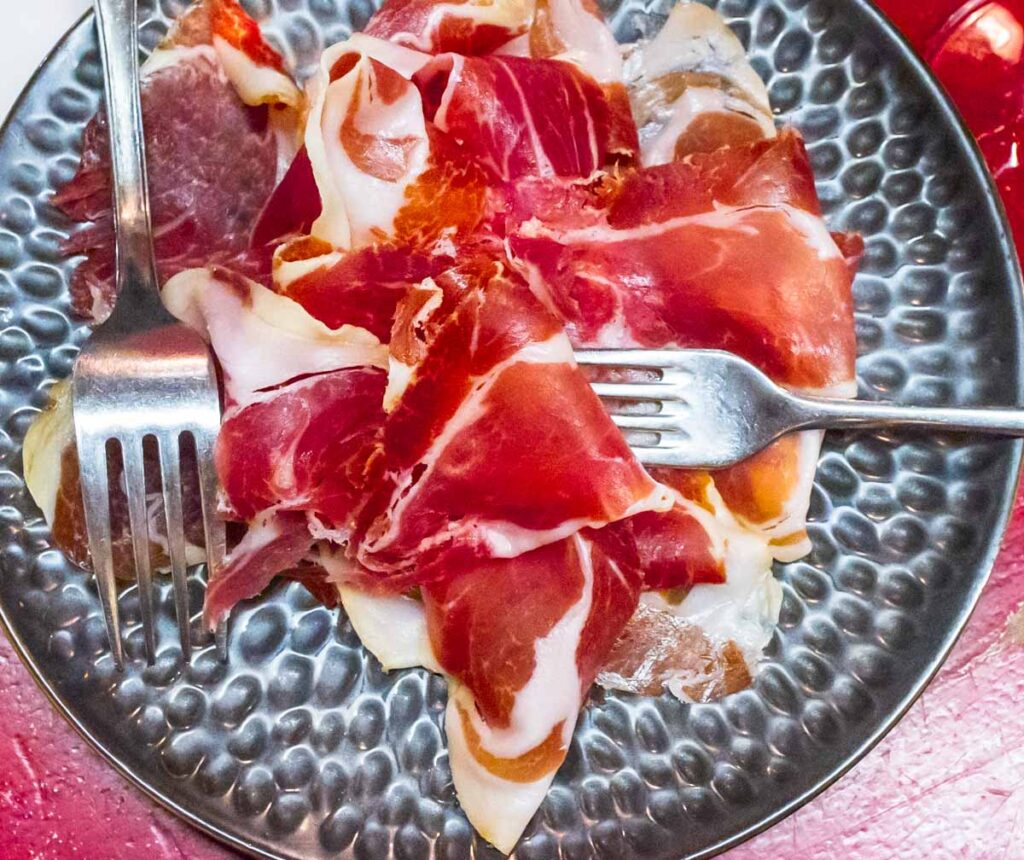
Coveted around the world, the best jamón Iberico is produced from black pigs that feast on acorns in fields in Extremadura, the Spanish region that borders Portugal. In Andalusia, jamón de Jabugo and jamon de Trevélez are two local jamóns to try. Thinly sliced plates of both are relatively easy to find at local tapas bars.
Pro Tip
Pair jamón Iberico with local sherry unless you’re more in the mood for red or white wine.
6. Habas con Jamón

With roots in Granada, habas con jamón is proof that all Andalusian jamón isn’t sliced and served on a plate. Made with haba (fava beans) and the aforementioned jamón, it’s also a dish where cultures collide. Moors and Sephardim ate beans back in the day while Catholics were partial to pork. Today, everybody eats habas con jamón, especially during the spring season when Andalusia’s beans are harvested.
Pro Tip
Skip red wine and pair this dish with white wine.
7. Churrasco

While Andalusia’s cured pork is justifiably famous around the world, its churrasco (grilled meat) is well worth eating too. Two popular cuts are Iberian secreto and presa, neither of which requires seasoning beyond salt. However, some restaurants choose to serve churrasco with sauce on the side.
Pro Tip
Don’t be surprised if you’re served grilled pork that’s cooked with a pink, or even red, center.
8. Mazamorra

Although it’s chilled like gazpacho and salmorejo, mazamorra is nothing like those tomato-based Andalusian soups. Instead, mazamorra gets much of its sweet flavor and thick texture from ground almonds. Fruit garnishes like pomegranate and raisins add both flavor and crunch. In Cordoba, our favorite mazamorra was served with pickled sardines on top.
Fun Fact
Mazamorra is similar to yet another chilled Andalusian soup – ajo blanco.
9. Olives and Olive Oil


It’s impossible to miss the olive trees when driving through the Córdoba and Jaén provinces in Andalusia. Those trees, which thrive in the region’s dry, hot climate, fill the horizon for as far as the eye can see. They also produce more olives than any other region in Spain.
It’s also impossible to miss the fruits harvested from those trees. Olives appear at the start of most restaurant meals and at tapas bars. And then there’s the olive oil that’s present in almost every local dish. It’s in the region’s soups as well as the fried dishes. It’s even an ingredient in some Andalusian dessert recipes.
Pro Tip
Expand your olive oil knowledge by taking an olive tasting in Andalusia. You’ll learn about the region’s DOP olive varieties and how extra virgin olive oil is different from other olive oils.
10. Pescaito Frito

Eating pescaito frito (fried fish) is nothing new in Andalusia. Sephardic Jews popularized pescaito frito centuries ago before taking the dish to Portugal and England after they fled the Inquisition.
Despite its globalization, Andalusia’s pescaito frito is special since it’s made with locally produced olive oil and fruit plucked from the Mediterranean Sea. That fruit includes anchovies, calamari, cuttlefish, dogfish and squid.
Pro Tip
Pair crispy pescaito frito with a crisp beer or two.
11. Espinacas con Garbanzos

Despite its lack of meat and fish, espinacas con garbanzos is a dish that practically screams Andalusia. The vegetarian dish, which features spinach and chickpeas as its main ingredients, has been on Seville menus for centuries. Spices like cumin and paprika add spice and flavor.
Fun Fact
While you can eat espinacas con garbanzos all year long, the dish is especially popular during winter and at Easter celebrations.
12. Tortilla de Patatas

Although the tortilla de patatas wasn’t invented in Andalusia, the dish made with potatoes, egg and olive oil is immensely popular throughout the region. It’s also a dish with a recipe that varies – sometimes it includes onion and sometimes it doesn’t.
Every Spanish abuela (grandmother) makes tortilla de patatas at home. If you don’t have an abuela, you can still eat the iconic omelet at tapas bars and other food stands. Don’t forget to pair your tortilla de patatas with salmorejo when you eat this heartwarming comfort food in Andalusia.
Pro Tip
Eat multiple tortillas de patatas to find out whether or not you’re on team onion.
13. Albóndigas

While Spain doesn’t get credit for inventing meatballs, Andalusian people have been eating albóndigas (meatballs) since the Moors introduced them centuries ago. However, these meatballs aren’t the same meatballs that Americans eat with spaghetti – some are made with meat while others are made with other proteins like chicken and cuttlefish. The best ones we ate were lightly colored, made of chicken and floated in a thick, savory broth.
Fun Fact
The Spanish word albóndigas derives from the Arabic word al-bunduq which loosely translates to hazelnut.
14. Berenjenas con Miel

With roots in Málaga, berenjenas con miel (eggplants with honey) is an ideal finger food and not just because the dish’s deep fried eggplants often look like little fingers. After frying the ‘little fingers’ in olive oil, cooks drizzle sugar cane honey on top to create a dish that’s simultaneously sweet and savory.
Fun Fact
Although they’re on Andalusian menus on a year-round basis, berenjenas con miel were originally eaten during the Hannukah holiday.
15. Chicharrón

Frying pork rinds in olive oil to create a crunchy bar snack is a concept that we can get behind whether we’re in Spain, Mexico or Portugal. However, there’s something special about eating chicharrones in Andalusia where the dish originated. Maybe they’re better here because Andalusia’s pork and olive oil are so great. Or maybe it’s the centuries of frying pork rinds that makes them better.
Fun Fact
The popularity of chicharrones extends beyond Iberia and the Americas. The crispy snack is also a food favorite in the Philippines.
16. Revueltas

Andalusia cooks fry eggs in olive oil along with a variety of ingredients like fresh vegetables, spicy chorizo and earthy mushrooms. Cheese is sometimes added to the mix too. The resulting dish, revueltas, is both messy and wonderful.
Pro Tip
You can eat revueltas for breakfast, lunch or dinner.
17. Croquetas

Andalusia cooks excel at frying croquetas filled with béchamel plus ingedients like jamón, salt cod and even fresh mushrooms. Is there anything that they don’t fry well? We’ve eaten all of these fritter varieties at tapas bars and restaurants around the region and they’ve all hit the spot.
Fun Fact
Although croquetas are popular throughout Spain, the fun finger food’s roots are in France.
18. Patatas Fritas

We didn’t expect to eat artisanal potato chips in the tiny town of Priego de Cordoba but that’s exactly what we did when we bit into San Nicasio’s patatas fritas. Sold in pretty pink bags, these crunchy chips are hand cooked in extra virgin olive oil and seasoned with pink Himalayan salt.
We’re not the only ones who like these tasty chips – Chef Jose Andrés serves them at his restaurants. And, while you can eat the chips at those restaurants or buy a bag online, the better and more fun option is to eat them in Andalusia.
Pro Tip
Eat San Nicasio’s patatas fritas with cured meat unless you prefer to eat them straight out of the bag.
19. Pan con Tomate

Not a fan of fried food? It’s still possible to enjoy Andalusia’s liquid gold. Not only are bottles of the stuff a fixture on most table tops, but olive oil is also present in numerous non-fried dishes.
One of those dishes, pan con tomate, is simply made with just three ingredients – toasted bread, tomato and olive oil. Some people add extra ingredients like garlic, coarse salt and fresh herbs to achieve extra flavor. Either way, eating pan con tomate is a fun way to start the day whether you eat at home or at an outdoor cafe.
Fun Fact
Pan con tomate is called pa amb tomàquet in its home region of Catalonia.
20. Ensaladilla Rusa

Ensaladilla Rusa was invented in Moscow and yet it appears at tapas bars all over Spain including Andalusia. And that’s not the only odd thing about Russian salad.
Despite its name, ensaladilla Rusa isn’t exactly a light bite. Instead, the salad is filled with a generous amount of mayonnaise. Other ingredients include potato, eggs, carrots, peas and canned tuna. Yes, it’s not that different from American potato salad.
Pro Tip
Look out for ensaladilla Rusa versions that replace canned tuna with fresh fish and other seafood delicacies.
21. Pionono

Invented in Santa Fé, a village 14 kilometers (approximately 9 miles) from Granada, the pionono is one of Andalusia’s most iconic desserts. It’s essentially a rolled miniature sponge cake that’s flavored with sugary syrup and topped with cream.
Eating the petite pastry inspired by Pope Pius IX (Pio Nono) is fun. Not only does the pionono honor the pope with its name, but the pastry is shaped like him too!
Pro Tip
Eat like a local and pair a pionono with coffee as an afternoon treat.
22. Pastel Cordobés

With roots in Córdoba, pastel cordobés is another iconic Andalucian dessert. This one is notable for its sweet jam, commonly called cabell d’ángel or angel’s hair, that’s made with either spaghetti squash or pumpkin.
Modern bakers fill puff pastry with that unique jam and dust each pastel cordobés with a generous amount of cinnamon and sugar. The resulting cake tastes great with a dollop of ice cream and even better when served with Montilla-Moriles dessert wine.
Fun Fact
The original pastel cordobés recipe included jamón which is ironic considering the dessert’s Muslim roots.
23. Torrijas

Often compared to French toast, torrijas sound like a trendy dessert. Instead, Spaniards have loved torrijas since nuns created the dessert at an Andalucian convent more than five centuries ago.
Today, home cooks and restaurant chefs prepare torrijas by soaking stale bread in a sweet eggy mixture before deep frying the soaked bread in olive oil. They then serve the dessert with a sweet topping, ice cream or both.
Fun Fact
Although they’re popular all year long, torrijas are especially popular during Lent and Holy Week.
24. Flan

Also known as crème caramel, flan is a custard that’s traveled the world.
The global dessert started out as a savory dish in ancient Rome before its popularity spread around the Roman empire. Thanks to Spaniards who transported the dish to the new world, flan eventually became a sweet dish. Fast forward to the present and flan is one of the most popular desserts all over Spain including Andalusia.
Fun Fact
Flan’s classic custard recipe has just four ingredients – eggs, milk, sugar and vanilla.
25. Churros

Churros were invented in Spain unless they were invented in China or Portugal. However, when it comes to churros’ popularity in Spanish regions like Andalusia, the exact origin doesn’t really matter. What matters is that the deep fried choux dough pastry tastes awesome when dipped into hot chocolate. And, when you think about it, frying churros in olive oil makes them an honorary Andalusian dessert.
Pro Tip
Why wait for dessert? Skip pan con tomate and eat churros for breakfast instead.
26. Café con Leche

Starting the morning with a piping hot cup of café con leche is non-negotiable for most food travelers when they’re in Spain. The drink, which literally translates to coffee with milk, typically combines espresso with hot milk in equal amounts.
Drinking a café con leche will get you through the morning, so you may need a second cup later in the afternoon. Another option is to drink a flat white if you’re in a bigger city like Córdoba or Granada.
Pro Tip
Add a packet or two of sugar if your café con leche is stronger than you prefer.
27. Montilla-Moriles Wine


Most Spanish wine enthusiasts are well versed in wines produced in La Rioja and Ribera del Duero; however, far fewer are familiar with wines produced in Montilla-Moriles despite its DOP (denominación de origen) status.
Located in Andalusia’s Córdoba province, Montilla-Moriles is notable for the Pedro Ximenez grapes that thrive in the wine region’s hot, dry climate. Skilled winemakers transform those grapes into dry white wines that pair well with food and sweet amber wines that are best imbibed with dessert.
Fun Fact
Montilla-Moriles winemakers use the same Pedro Ximenez grapes that Jerez producers use to produce sherry.
28. Vino de Naranja

Winemakers in Andalusia have been producing vino de naranja (orange wine) with locally grown grapes and orange peel for more than a century. However, not all vino de naranja in Andalusia is the same. Málaga’s vino de naranja is sweet while Seville’s vino de naranja skews bitter. The colors vary too.
Fun Fact
Unlike Andalusia’s vino de naranja, the orange wine in countries like Austria and Georgia aren’t produced with oranges or orange peel.
29. Tinto de Verano

The Tinto de Verano is a wine cocktail that’s crafted with just two ingredients, red wine and lemon-lime soda. It’s the drink of choice at Andalusia tapas bars during the region’s hot summer months. Often served on tap or in bottles, the refreshing drink is similar to sangria but far easier to make.
Fun Fact
Legend has it that a Cordoba bartender crafted the original Tinto de Verano more than a century ago with equal parts of red wine and Gaseosa, i.e. lemon soda. Today, many mixologists replace Gaseosa with Fanta, Seven-Up or Sprite while others use lemonade instead.
30. Sherry

We first sipped sweet Pedro Ximenez sherry in Philadelphia without realizing that the fortified wine is only produced in Andalusia. Back then, we also didn’t realize that there are several sherry styles including fino, manzanilla, manzanilla pasada, amontillado, palo cortado, oloroso and dulce. Each style is special with its own aging process and flavor profile.
Pro Tip
Travel to Jerez, near Cádiz, and taste different sherry varities. It’s the best way to find your favorite.
💡 Frequently Asked Questions
Andalusia is famous for a variety of Spanish food favorites including tapas, rabo de toro, salmorejo and flamenquín.
Food in Andalusia ranges from cheap eats to fine dining. In other words, you can easily eat for well under 50€ a day or blow it out and spend much more.
No. Tipping is optional in Spain.
Reservations are necessary at popular Andalusia restaurants. While you should be able to walk into many Andalusia tapas bars without a reservation, it’s always a good idea to call ahead to be sure.
🇪🇸 Andalusia Travel Checklist
🎥 Video Recap

⚙️ Disclosures
Article Updates
We update our articles regularly. Some updates are major, while others are minor link changes and spelling corrections. Let us know if you see anything that needs to be updated in this article.
Sponsorship
We thank UnTours for sponsoring our participation in the inaugural Andalusia Food and Wine UnTour. We also thank Devour Tours for sponsoring our food-focused trip to Seville.
📍 Pin This Article


