

Uncovering Andalusian Flavors with UnTours
This article contains affiliate links. We may receive compensation if you make a purchase using one of these links at no additional cost to you. See our Disclaimers and Terms of Use for more information.

Discover what it’s like to explore the flavors of Andalusia with UnTours. Our week-long Andalusia food & wine experience took us on a culinary journey through the heart of Spain.

Priego de Córdoba, a small white hill town surrounded by olive groves, isn’t the first town people think of when they plan their dream trip to southern Spain. Yet, despite its under the radar status, our initial walk through the quiet narrow streets of the town’s old Jewish quarter immediately impacted us.
Since our visit was in spring, the walls of the quarter were decorated with flower pots in full bloom. After following winding streets to the town’s fringes, we reached a sharp cliffside overlook. Olive trees, as far as the eyes could see, created a fabric on the steep hills surrounding the ancient town.

Regardless of their goals, few travelers take the time to visit towns like Priego de Córdoba. However, this is the kind of town where real Andalusian life still exists. And, since the region has countless mountains and miles of meadows, there’s a heck of a lot to see and plenty of great food to eat away from the tourist track in cities like Córdoba, Granada, Málaga and Seville.
It’s not just topography and climate that make the food in Andalusia special. The region’s cuisine is a veritable melting pot with distinct influences provided by Moors, Romans and Sephardic Jews who lived in the region over the centuries. While many of those people are long gone from Andalusia, their influences are ever-present in the region’s cuisine.
Our Andalusia Food and Wine Experience


Hungry to taste all of Andalusia’s diverse food, we jumped at the chance to join UnTours’ multi-day inaugural Andalusia food and wine experience.
While the company usually provides loose itineries for independent travelers looking to live like locals, our week-long experience was similar but different from the typical UnTours package. As is the case with other UnTourists, we stayed in an apartment and immersed ourselves in local life. However, this Andalusia experience ramped things up with culinary-themed group activities each day.
Here’s the low-down on everything we did and ate during our culinary UnTour:
Day One: Arrival and Welcome Dinner

Our journey to Andalusia was an adventure in itself that involved an Uber ride to the Lisbon airport, a flight to Madrid, lunch at a world class pizzeria, a high-speed train ride to Málaga and a scenic drive to the charming town Priego de Córdoba. It sounds exhausting and it was. But it wasn’t all bad since the three-hour train ride gave us ample time to rest our eyes when we weren’t gazing out the window.


Our UnTours guide Pablo greeted us and escorted us to our home for the week. A butcher by trade, Pablo helped us situate in our two-bedroom apartment while sharing some detals about the week ahead. The apartment had a stocked refrigerator as well as basic amenities like WiFi, a parking space and a washing machine.

Our welcome meal with our fellow intrepid food travelers (Susan and Roger) plus Pablo was a casual yet grand affair that involved multiple dishes plus wine. We got our first tastes of Andalusia during that meal.


Our favorite dishes of the night were flamenquin, Andusia’s spin on roulade, and a tomahawk steak made with local Iberico pork and cooked to a wonderful rosy hue. Desserts like crunchy, sugary leche frita completed the evening’s festivities.
Day Two: Exploring Priego de Córdoba and Cooking Demo

We started our first full day in Andalusia slowly, as most locals do on Sundays, with pan con tomate at a local Priego de Córdoba cafe. This particular version of the Spanish classic came self serve with hunks of plain bread and a side of lightly pureed tomatoes with a spoon for spreading. We washed the tomato bread down with café con leche – Spain’s version of coffee with milk.
The typical Spanish breakfast energized us to tour the compact Andalusian city known for its baroque chuches, an ancient fortified castle, intimate parks and romantic fountains.


Spending much of the day acclimating to our home for the week, we wandered around the Barrio de la Villa, i.e. the Jewish Quarter, and explored the castle’s ruins. Our self-guided walking tour took us from one end of the small town to the other with ample time to break for lunch. We even indulged in a siesta before heading to the day’s main event – a cooking demo.
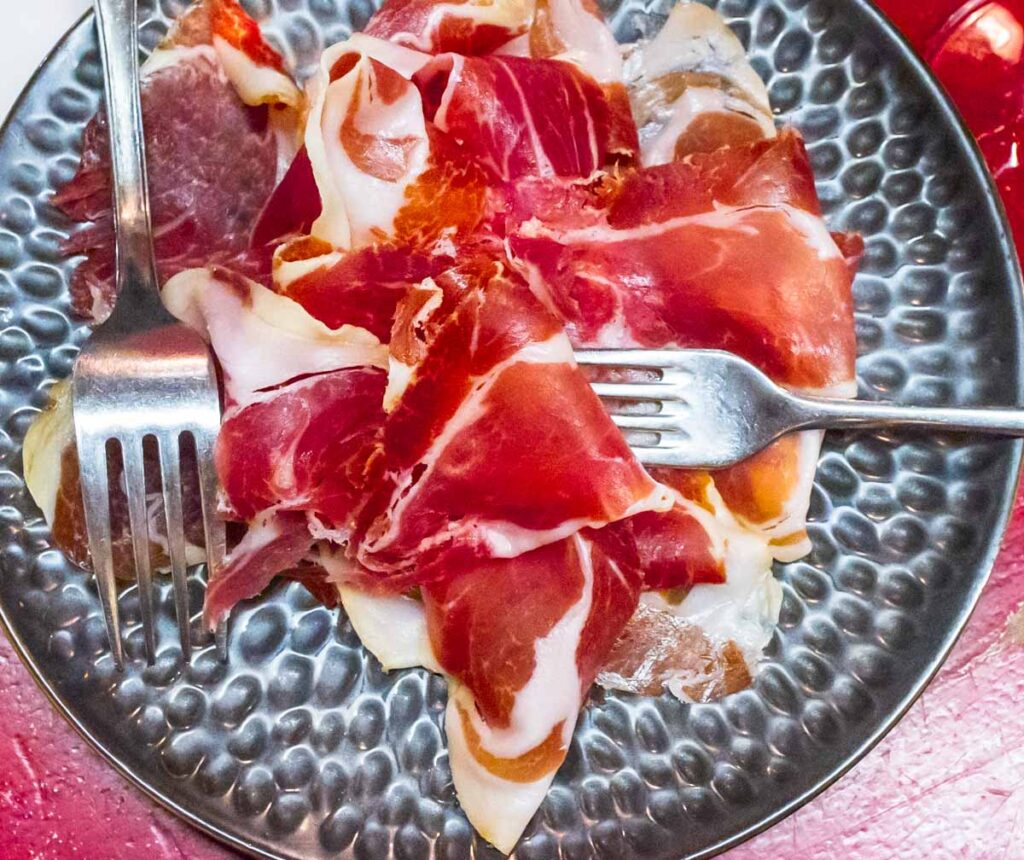
Pablo, our UnGuide, welcomed us into his family’s home with sangria and a plate of cured meat topped with potato chips. Pablo showed us how to cook two iconic dishes – salmorejo and tortilla de patatas.

Salmorejo, a cold tomato soup, is similar to gazpacho but the two Spanish soups aren’t the same. Unlike gazpacho, salmorejo is eaten out of a bowl where gazpacho is sipped from a glass. Using a blender, Pablo whipped up a batch using local ingredients that included day-old bread, olive oil, green pepper, sherry vinegar, garlic and salt.
Pablo confided that locals eat salmorejo every day during the region’s hot summer months. After eating multiple bowls during the week, we fully condone this tradition.

Unlike salmorejo, tortilla de patatas isn’t an Andalusian dish – it’s popular all over Spain.
Many Spaniards learn how to cook the dish from their abuelas (i.e. grandmothers). Pablo is no exception. For the demo, his goal was to create an omelette with a crispy shell and a soft center using just four ingredients – potatoes, onion, eggs and olive oil. Pablo taught us how to know when the potatoes are finished and how to properly flip the omelette once it’s browned. And, yes, he achieved his goal.
Day Three: Winery Tour

Not missing a beat, our group of five left Priego de Córdoba in the morning for a 45-minute drive to Bodegas Alvear in Andalusia’s Montilla-Moriles wine region. With a history that dates back eight generations to 1729, Bodegas Alvear is Andalusia’s oldest winery and the second oldest in all of Spain. It’s also a great spot to learn about Andalusian vinoculture, starting with the regions unique, chalky terroir.

Montilla’s white albariza soil is ideal for growing Pedro Ximénez grapes – it retains humidity despite the region’s hot climate. When we picked up a white rock on the vineyard’s surface, it literally broke in our hands.
Each July, the winery staff manually picks grapes from fields that peak at 700 meters. They transform some of the grapes into dry white wine while other grapes are sun dried, concentrating their sugar to create dessert wines. And, in case you’re wondering, Alvear‘s Pedro Ximénez wine is differerent from Pedro Ximénez sherry produced in nearby Jerez.
We then proceeded to the best part of our vine to bottle tour – tasting the wine.


We first tasted Tres Miradas de Alvear, Pedro Ximénez wine aged in vats under a veil of flor (i.e. yeast), while standing next to Pedro Ximénez vines. With a 13.5% ABV, the amber-colored white wine was dry, complex and funky.
Our tour ended with a second tasting inside a builiding filled with century-old clay amphoras. Produced with Pedro Ximénez raisins aged in those vessels for two years, the sweet Añada wine packed a punch with its 16% ABV. The thick amber wine had a wonderful aroma filled with scents of dried fruit.


After the wine tour, we spent the afternoon on our own in Jaén. Located less than an hour from Priego de Córdoba, the Andalusia city has several notable sites including a 16th century renaissance-style cathedral where visitors can see the Holy Veil of Veronica. The city also has numerous restaurants that serve tapas and wine.
Day Four: Córdoba Day Trip


After an hour and 15 minutes drive to Córdoba and some much needed cups of coffee, we started the day with a tour of the city’s ancient Jewish quarter. The neighborhood’s winding streets provided us with a glimpse into the city’s Sephardic Jewish history as did a historic building that functioned as a synogogue prior to the Sephardim’s expulsion in 1492. Stopping at the quarter’s Maimónides statue gave us the chance to rub Mosén Ben Maimón feet for good luck as one does.
La Mezquita – Is it a Mosque or a Church?

We had previously read about La Mezquita but there’s nothing like seeing Córdoba’s mosque-cathedral in person. Now a UNESCO heritage site, the massive building has a history that spans back to the seventh century.


Originally constructed by the Moors to be mosque, Le Mezquita now operates as both as a Catholic church and a tourist destination. It’s also huge and filled with Islamic arches that make way for one of the most ornate catholic cathedrals in all of Europe. Southern Spain has been marked by many cultural changes and we saw many of them in this holy place.
After exploring La Mezquita, we ready for our next stop – lunch.


We didn’t have to walkf far for our lunch at Restaurante Almudaina – the restaurant is located in a converted palace just outside the Mezquita walls. While there, we sipped locally produced wine and shared a selection of classic Córdoba dishes like salmorejo, mazamorra and rabo de toro (Spain’s signature oxtail stew). A slice of pastel cordobés, the city’s unique laminated sugar-dusted pastry filled with sweet pumpkin filling, ended the mid-day meal on a sweet note.
Day Five: Olive Oil Tour

A sea of 1,200 olive trees greeted us when we arrived at Aceites Vizcánta’s olive grove. The grove’s trees produce three varieties of DOP olives – picore, picual and hojiblanca. One, a wild picore tree, has been producing olives for over a millenium.

The Phoenicians brought olives and olive oil to Spain more than a thousand years ago. After they left, the Romans continued cultivating olive trees and, later, the Muslims perfected the olive oil process.
Today, the Spanish are immensely proud of their day olive oil industry. There’s some debate between them, the Greeks and the Italians about which country produces the best product but, at least among Spaniards, there’s no debate that Spain produces the best olive oil in the world.
Our guide Luis, a Mexican native, was fierce about the quality of Spain’s olive oil. He’s an excellent teacher who showed us the intricacies of great olive oil from cultivation to tasting.


After touring the grove, Luis gave us a brief education about Spanish olives. We learned about Andalusia’s key olive varietals, the September harvest and how blending olive varietals creates a better product. The information all came together when we started tasting different olive oils using the same process that official tasters follow.
We’ve done other olive oil tastings before and this was the best we’ve experienced. We learned how to differentiate refined oil from virgin olive oil and what makes extra virgin olive oil superior. Plus, we met a 1,000 year old olive tree which was pretty awesome.
Day Six: Granada Day Trip

Located an hour from Priego de Córdoba, Granada is a popular destination thanks to the Alhambra, the city’s ancient Islamic palace/fortress. Although more than two million people visit the Alhambra each year, we weren’t two of those people. Instead, we spent our day walking through the city’s most historic neighborhoods and eating tapas. Don’t worry – we’ll visit the epic Islamic palace during a future Granada trip.


We started our walk in the Albaicín, Granada’s old Muslim quarter, where the air smelled of orange blossoms and incense. Not messing around, we promptly found a cafe and ordered coffee and local pastries. We then proceeded to walk through time on cobblestone sidewalks, stopping to admire the Mirador de San Nicolás which Bill Clinton declared to have “the most beautiful sunseet in the world.” While we didn’t see a sunset there, we did enounter a guitarist playing flamenco music.

After walking though the Sacromonte, our guided walking tour conveniently ended in the center of town near the city’s best tapas bars.
In other words, it was time for a mini tapas tour!
While tapas is popular all over Spain, it’s especially popular in Granada where it’s standard for tapas bars to provide free food to all who purchase drinks. Pablo, who attended univiersity in Granada, started our tapas tour at one of his old haunts, Los Diamantes.


The popular seafood restaurant has been serving seafood to locals since 1942. There wasn’t an empty seat in the joint during our visit. When we walked out the door, there also wasn’t any food left on our plates which had started out topped with fried shrimp, squid and dogfish.
Our second stop at Bodegas Castañeda was a highlight of both the day and the week. Open since 1927, the traditional tapas bar specializes in two of our favorite Spanish things – jamon and vermut. Not wanting us to miss a bite, Pablo ordered a big tabla (i.e. board) topped with a variety of cured meats plus cheeses, cured tuna, cured salmon and almonds. Additional little plates appeared when we ordered glasses of calicasas, a pleasantly potent blend of vermut, gin, rum, soda and spices.


Bodegas Casteñeda fills with people crowding to eat tapas under the watchful eye of the bull perched above the far end of the bar. Barrels of vermut line the walls which is convenient for bartenders who quickly fill glasses for the thirsty throng.
Day Seven: Leisure Day and Farewell Dinner

Momentarily tempted to spend the day chillaxing in Priego de Córdoba, we rallied the troops (i.e. us) and headed to Córdoba for the day. Unlike our previous visit earlier in the week, we spent much of the day walking around modern parts of the city. Yes, this was a 20,000+ step day.


We stopped for flat whites, bought a couple souvenirs, ate tapas and shared a ‘tres chocolat’ sundae’ topped with whipped cream, chocolate sauce and a plump berry. To us, that berry was the proverbial cherry on top of our literal sundae.


Since we started our Andalusia UnTour with a welcome dinner, it was fitting to end the week with a farewell dinner. We met the team, i.e. Pablo, Susan and Roger, at Zyrah Gastrobar for a multi-course meal, glasses of wine and the chance to revist the week’s highlights. It was a fitting conclusion to the food-focused week.

💡 Frequently Asked Questions
Founded in 1957, UnTours is America’s first B Corp. Now operated by the UnTours Foundation, the company plans independent UnTrips with the help of local UnGuides. Beyond local guidance, UnTrips typically include accomodation, transportation and loose itineraries.
UnTours makes it easy for independent travelers to live like locals in European destinations as well as in Costa Rica and Mexico. This style of travel is ideal for both busy people who don’t have time to plan trips and slow travelers who value having a safety net during their trips.
Andalusia is in southern Spain. The region’s major cities include Córdoba, Granada, Málaga and Seville.
Andalusia is famous for a variety of Spanish food favorites including tapas, rabo de toro, salmorejo and flamenquín.
🇪🇸 Andalusia Travel Checklist


⚙️ Disclosures
Article Updates
We update our articles regularly. Some updates are major while others are minor link changes and spelling corrections. Let us know if you see anything that needs to be updated in this article.
Sponsorship
We thank UnTours for sponsoring our participaton in the innaugural Andalusia Food and Wine UnTour.
📍 Pin This Article

