

Portuguese Chestnut Rice: Arroz de Castanhas
This article contains affiliate links. We may receive compensation if you make a purchase using one of these links at no additional cost to you. See our Disclaimers and Terms of Use for more information.


When we were growing up in America, chestnuts were more of a holiday song lyric than something we ate. Here in Portugal, where we live, they’re impossible to avoid. Bins overflow with the burnished brown beauties at both public markets and supermarkets. Starting in September, the smoky aroma of roasted chestnuts fills the air in Lisbon’s busiest neighborhoods. On St. Martin’s Day (November 11), locals celebrate magusto with roast chestnuts and new wine.
Why the chestnut infatuation? They’re delicious. We like to crack them open and eat them plain, without even a hint of salt. Can a nut have umami? In the case of chestnuts, we say yes. They have a deep, mellow sweetness and a lingering flavor that’s as warm as autumn’s colorful leaves.

So why do chestnuts seem so exotic to Americans? Blame a blight that arrived in the early 20th century and practically wiped out the American chestnut over the following decades.
Before the blight, chestnut trees were everywhere. In Appalachian forests, about one in four trees was a chestnut. People ate the nuts and used the wood to build homes and furniture. By the time Robert Wells and Mel Tormé wrote The Christmas Song in 1945, roasting chestnuts by the fire was already a nostalgic image. Today, when Americans hear the word chestnut, they think of the song first.

If more Americans tasted Portugal’s chestnut rice, they’d see the nut in an entirely new light.
🍽️ This Recipe at a Glance
- Arroz de castanhas is a classic Portuguese side dish. It’s essentially rice simmered with chestnuts in homemade chicken stock.
- Portugal’s chestnut rice dish is cooked malandrinho-style. The finished rice is loose, starchy and saucy. It reminds us of a soupier risotto, but it’s totally Portuguese.
- A single knife cut and a 15-minute steam make fresh chestnuts easy to peel.
- You can make the stock and shell the chestnuts a few hours ahead.
- Serve chestnut rice with turkey at Thanksgiving or with roast chicken any night in the fall.
What Is Chestnut Rice?
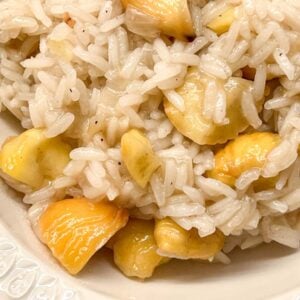
Arroz de castanhas (i.e., chestnut rice) is a traditional Portuguese side dish of rice cooked in chicken stock with chestnuts, onion, garlic and olive oil. In some ways, it’s similar to risotto but soupier. The Portuguese call this loose, saucy style of rice malandrinho.
The hardest part of this simple recipe is shelling the chestnuts. Once that’s done and the stock is ready, the rice comes together in about 30 minutes. The result is slightly starchy, somewhat saucy and utterly delicious.
Ingredients

The work in this recipe lies in shelling the chestnuts and preparing the stock. Its ingredient list is both easy to procure and easy to remember. Here’s everything you need:
Ingredient quantities are detailed in the printable recipe card below.
How To Make Chestnut Rice

We based our chestnut rice recipe on a recipe in Leandro Carreira’s Portugal: The Cookbook. Carreira is a serious chef with big-time accolades in both Portugal and England. His cookbook, which we recommend, is written for experienced cooks and leans toward a British audience. If you’re American, you’ll need to tweak his recipes, which is what we’ve done here.
We adapted this chestnut rice recipe to include American measurements and practical proportions. We also included a handy technique for shelling fresh chestnuts. Shelling is a labor of love, and it will make you proud when you serve the dish to your friends and family.
Make the Stock


Place the peeled carrot, chicken bones, whole garlic cloves and halved onions in a 6-quart stock pot. Cover with 1 1/2 quarts of water. Bring the pot to a rapid simmer over high heat and skim the foam off the top.
Turn the heat to low and simmer the stock for about an hour. Strain it through a fine mesh strainer and discard the solids.

You should have about one quart of stock. If you have less, add water to bring it up to a quart. Return the stock to the rinsed pot and keep it warm over low heat.
Pro Tip
You want the stock to be hot when you add it to the rice.
Shell the Chestnuts


Shell the chestnuts while the stock simmers. We discovered an easy way to do this with a medium chef’s knife. Simply cut a single line across the rounded side of each chestnut. Don’t worry if your knife nicks the nut inside.
Bring about an inch of water to a boil in a pot fitted with a steamer basket or attachment. Steam the chestnuts, covered, for 15 to 20 minutes, until the shells split open.
Peel the chestnuts while they’re still warm. Consider yourself warned that the fuzzy inner skin can stick. If it does, push the nut out through the flat back of the shell, and the skin should come off with it. The more chestnuts you peel, the faster you’ll get.

Cut the peeled chestnuts into quarters and set them aside.
Pro Tip
Have the quartered chestnuts, chopped onion and minced garlic ready to go before you strain the stock.
Make the Refogado

Pour the olive oil into a 4-quart saucepan and add the chopped onion and minced garlic. Add a small pinch of salt and cook over medium heat for about 10 minutes, stirring often, until the onion turns golden. Don’t let the garlic burn.

Add the quartered chestnuts along with generous pinches of salt and black pepper. Stir until everything is combined.
Pro Tip
Chestnuts pack a flavor punch, so they need a good amount of salt.
Cook the Rice


Add the rice and stir for about 5 minutes to coat it in the oil.
Add the hot stock and bring the pot to a simmer over medium-high heat. Cook for about 15 minutes, stirring frequently, until the rice is tender but still has a little bite.
The rice will be a little wet with a starchy, saucy texture. That’s malandrinho-style, and it’s exactly what you want.
Serve

Serve chestnut rice as a holiday side. It pairs well with roast chicken, turkey or whatever protein you serve at your autumn meal.
You can also eat chestnut rice on its own. Leftovers taste great reheated or straight out of the refrigerator.

Portuguese Chestnut Rice Recipe
Ingredients
For the Stock
- 1 pound chicken bones
- 1 large carrot (peeled)
- 2 medium onions (peeled and halved)
- 2 garlic cloves (whole, peeled)
- 1 ½ quarts water
For the Rice
- 3/4 pound chestnuts (in the shell)
- ⅓ cup olive oil (extra virgin)
- 1 medium onion (finely chopped)
- 2 garlic cloves (minced)
- 1 ½ cups rice (long-grain)
- salt (to taste)
- black pepper (to taste)
Equipment
- 1 4-Quart Stainless Steel Saucepan
Instructions
- Place the chicken bones, carrot, halved onions and whole garlic cloves in a 6-quart stock pot with 1 1/2 quarts of water. Bring to a simmer over high heat, skimming off the foam that rises to the top. Reduce the heat to low and simmer for one hour. Strain the stock through a fine mesh strainer and discard the solids. You should have a quart of stock. If you have less, add water to bring it up to a quart. Return the stock to the rinsed pot and keep it hot over low heat.
- While the stock simmers, use a sharp medium knife to cut a line across the rounded side of each chestnut. (Don’t worry if the knife cuts into the nut.) Steam the chestnuts, covered, until the shells open, about 15 minutes for small chestnuts and 20 minutes for large ones.
- Peel the chestnuts while they’re warm, discard the shells and inner skins and cut the chestnuts into quarters.
- Pour the olive oil into a 4-quart saucepan and add the chopped onion, minced garlic and a pinch of salt. Cook over medium heat for about 10 minutes, stirring frequently, until golden. Don’t let the onion and garlic burn.
- Add the quartered chestnuts and season generously with salt and pepper. Stir to combine.
- Add the rice and cook, stirring frequently, for about 5 minutes. Add the hot stock and bring to a simmer over medium-high heat. Cook, stirring frequently, until the rice is tender but still has a little bite, about 15 minutes. The rice should be a little wet with a starchy, saucy texture.
- Serve with chicken, turkey or another protein.
Notes
- You can steam and peel the chestnuts a few hours ahead. Cover them and refrigerate them until you’re ready to cook.
- You can substitute about 1/2 pound of frozen peeled chestnuts for fresh chestnuts. Skip the steaming and peeling steps.
- If you don’t have chicken bones, use 1 quart of bottled unseasoned chicken bone broth. Don’t use boxed chicken stock.
- Store leftover chestnut rice in the refrigerator for up to three days. Reheat it over low to medium heat with a splash of water, stirring frequently.
Nutrition
💡 Frequently Asked Questions
Chestnut rice (arroz de castanhas) is a Portuguese side dish of rice cooked in chicken stock with chestnuts, onion, garlic and olive oil. It’s served loose and saucy, malandrinho-style.
Malandrinho describes Portuguese rice that’s cooked with extra liquid and served wet. The texture falls somewhere between risotto and soup.
Cut a line across the rounded side of each chestnut, steam them for 15 to 20 minutes and peel them while they’re still warm. (The inner skin sticks once the nuts cool.)
Yes. Frozen peeled chestnuts save time. Skip the steaming step and add them to the pot after you add the onion and garlic. Vacuum-packed precooked chestnuts work too.
We use long-grain rice. Portuguese carolino rice gives you a creamier texture if you can find it.
You can make the stock and shell the chestnuts a few hours ahead. The rice is best served right away, but leftovers keep in the refrigerator for up to three days.
🍚 More Rice Recipes



📍 Pin This Recipe


⚙️ Disclosures
Article Updates
We update our articles regularly. Some updates are major while others are minor link changes and spelling corrections. Let us know if you see anything that needs to be updated in this article.
Funding
We purchased the ingredients and tools used to create this recipe.
